
How to choose an AI HR assistant that cites employment law and official sources
10 min read · Published September 4, 2026
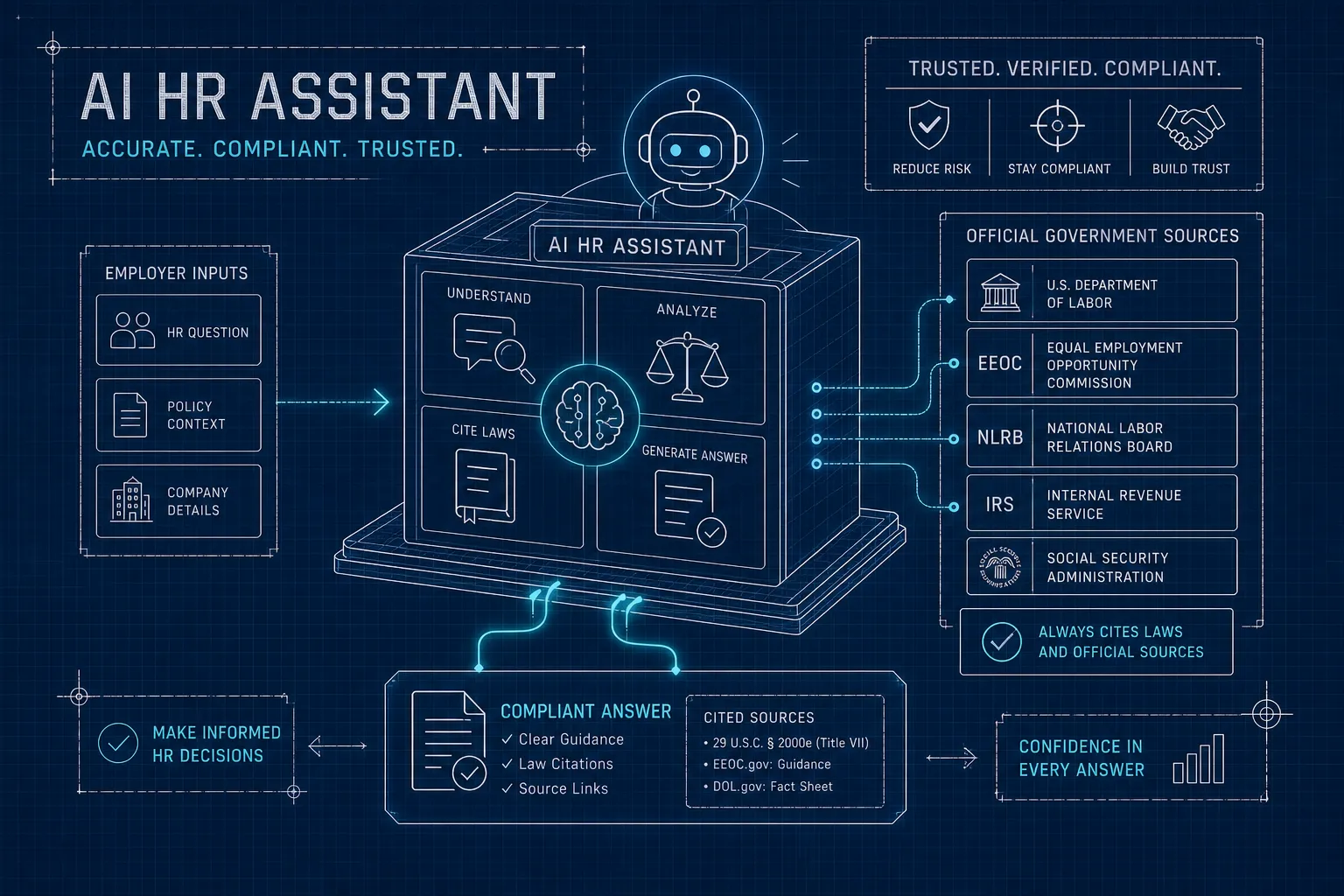
You have people in three states. Payroll asks whether a salaried coordinator at $62,000 is exempt from overtime. You paste the question into whichever AI assistant your company already pays for, and back comes a clean paragraph: a bolded number, a confident conclusion, and something that looks like a statute underneath it.
The paragraph is the easy part; any general-purpose model produces one. The question that decides whether a tool belongs near a compliance file is narrower: what is that citation actually doing? Is it a link the tool followed, a record it matched against, or a string it generated because citations are what legal answers look like? For most products it is the third, and asking precisely is what turns a demo into a shortlist.
"Cited" and "verified" are not the same property
Treat citation as a ladder with four rungs — vendors describe all four with the same word.
- Asserted. The tool emits a string shaped like a citation. Nothing checked that the section exists. It is what produces a plausible statute number attached to a rule from somewhere else entirely.
- Retrieved. The tool searched a real corpus and the authority behind the link genuinely exists. Better — but existence is not relevance.
- Checked. The authority is confirmed real and its status examined: still good law, superseded, vacated, repealed.
- Verified against the statement. The cited authority is checked to see whether it actually supports the sentence it is attached to — and the tool flags the sentence when it does not.
Almost every product operates at rung two or three. Across the tools surveyed here, producing citations is universal and checking them is common; exactly one documents flagging statements its own authority does not support. That gap is the most useful thing a buyer can know, because rung-three tools fail in a specific way: a real, live, correctly formatted statute sitting under a sentence the statute does not say.
Five things to test before you buy
1. Does it name the governing authority, or only the rule?
Ask a question whose answer differs by state, and watch whether the tool tells you which law it is applying. California's white-collar salary floor is not a memorized number; it is a formula — twice the state minimum wage for full-time work, under Labor Code § 515 — which at the 2026 state minimum of $16.90 an hour produces $70,304 a year. Federal law sets a flat $684 per week. A tool that gives the number without the mechanism cannot tell you what happens when the minimum wage moves; one that gives the mechanism has shown you how to check it yourself next year.
2. Does it resolve jurisdiction before it answers?
Nevada is the cleanest test. Daily overtime exists there, but only for employees earning less than one and a half times the minimum wage — $18.00 an hour against Nevada's $12.00 minimum. Under NRS 608.018, someone at $17.00 an hour gets overtime after eight hours in a 24-hour period, and someone at $19.00 an hour does not. Most assistants answer either "Nevada has daily overtime" or "Nevada follows the federal 40-hour rule." Both are half right, which in practice is wrong.
3. Does it distinguish statute, regulation, case law and agency guidance?
These are not interchangeable, and the last two years have punished the confusion. Loper Bright Enterprises v. Raimondo (U.S. 2024) overruled Chevron deference, so agency sub-regulatory guidance is now persuasive rather than binding. Guidance also disappears without the statute moving: the EEOC rescinded its 2024 harassment enforcement guidance in January 2026, while Title VII itself is unchanged — a removed document is not a repealed law. And the Department of Labor's 2024 overtime rule, which would have raised the exempt salary to $1,128 a week, was vacated nationwide (State of Texas v. U.S. Dep't of Labor, 756 F. Supp. 3d 361 (E.D. Tex. Nov. 15, 2024)); the 2019 levels are the ones in force. An assistant trained on 2024 web text, with no way to check status, hands you $1,128 with total composure: real rule, real citation, dead law.
4. Does it check its own citations, and against what?
Here the marketing language needs reading word by word. "Citations from primary sources" describes retrieval. "Checks whether cited authorities can be matched to available records" describes existence-checking, against whatever those records happen to cover. "Flags unsupported statements" describes something else entirely. Put the blunt version to every vendor: what does your citation feature compare, to what, and what does it do when the two disagree?
Ask what is in the corpus, too: a tool that searches case law does not thereby search statutes and regulations, and most HR questions turn on a statute, a wage order or an agency rule, not a court opinion.
5. Does it date its answers and admit uncertainty?
Utah's private-employer E-Verify mandate applies at 150 or more employees under Utah Code § 13-47-201 — and that chapter carries a contingent repeal, so a complete answer warns you to confirm the section is still operative. Florida's mandate applies at 25 or more under Fla. Stat. § 448.095; two 2026 bills that would have extended it to all private employers both died in committee in March 2026, so the operative threshold is still 25. A tool that says "25 or more employees" and stops is correct. A tool that adds "pending legislation may expand this" without checking is generating atmosphere.
What the named products actually claim — a snapshot taken 2026-09-03
Vendor pages change without notice. Everything below was read on the vendor's own page or marketplace listing on that date and is quoted rather than paraphrased. None of it has been independently tested.
| Product | Vendor | What the vendor's own page documents |
|---|---|---|
| Ask HR AI | SafestHires | Advisor Mode "returns a case-style memo with applicable law, recommended steps, documentation tips, and citations." Separately marketed as answering "U.S. HR compliance questions with jurisdiction-specific citations." |
| Irys One | Irys | "Case law research across federal and state courts"; "search across U.S. case law"; "Jurisdiction filtering. Federal circuits, district courts, all 50 states"; "Inline citations from primary legal sources"; a Cite Check that "checks whether cited authorities can be matched to available case records." |
| G-P Gia | Globalization Partners, listed on the ADP Marketplace | "Contextual Mapping: Gia identifies the specific jurisdiction (e.g., a specific country or U.S. state) and the applicable local labor laws"; "Direct Citations: Every response Gia provides is backed by specific references." |
| Lexis+ with Protege | LexisNexis | "Shepard's Verify checks citations in AI responses, documents, and drafts — surfacing legal authority and flagging unsupported statements." |
Read against the ladder, the pattern is legible. Ask HR AI is a free tool from a background-screening company rather than a legal-research product; the memo structure is a real differentiator, and the two claims above appear as separate sentences, not one combined promise. Irys One documents case law only — its materials do not claim statutory or regulatory coverage, and its Cite Check matches cited authorities to available case records, which is existence-checking rather than support-checking. G-P Gia is positioned around global HR and employer-of-record work; its listing claims coverage across 50 countries and all 50 U.S. states, so treat it as broad rather than thin on the U.S.; jurisdiction identification is exactly the failure mode in criterion two. Lexis+ with Protege is the only one of the four whose documented feature reaches the fourth rung — and it is built and priced as a lawyer's research platform, a different purchase from an HR assistant.
A rubric you can run in an afternoon
Score each criterion 0 (absent), 1 (claimed), or 2 (demonstrated on your own question, not the demo's).
| Criterion | Weight | What a 2 looks like |
|---|---|---|
| Names the governing authority, not just the rule | 3 | Cites the section and explains the mechanism |
| Resolves jurisdiction before answering | 3 | Asks, or states its assumption inside the answer |
| Corpus covers statutes and regulations, not only case law | 3 | Vendor will name the sources and the update cadence |
| Distinguishes binding law from agency guidance | 2 | Flags rescinded, vacated or contested authority |
| Checks citations against their source | 2 | Vendor can say what is compared to what |
| Flags statements the cited authority does not support | 3 | Documented, not implied |
| Dates its answers and says when it does not know | 2 | "As of" language; refusals instead of guesses |
Then run the same questions past every tool, grading the citation rather than the prose:
- Nevada, employee at $17.00 an hour, nine hours in a day — is daily overtime owed? (Yes; NRS 608.018.)
- Arizona, employee out sick two consecutive days — may the employer demand documentation? (No; documentation may be required only for three or more consecutive work days, A.R.S. § 23-373(G).)
- Pennsylvania, salaried non-exempt employee, 46 hours — may you use the FLSA fluctuating-workweek half-time multiplier? (No; and the regular rate is the weekly remuneration divided by 40, 34 Pa. Code § 231.43(g).)
- Texas, employee discharged on a Monday — when is final pay due? (Within six calendar days; Tex. Labor Code § 61.014.)
- Federal, FMLA medical certification comes back incomplete — what must the employer do before denying leave? (State in writing what is missing and allow seven calendar days to cure; 29 C.F.R. § 825.305(c).)
- Federal, current weekly salary threshold for the white-collar exemptions. (If the answer is $1,128, stop the evaluation.)
Each has a checkable answer with a primary source behind it. Keeping a threshold table open while you grade makes it faster.
What nobody can tell you
There is no independent benchmark of citation accuracy across these tools. No neutral party has run them against a shared question set and published error rates, so every claim on every vendor page — including those quoted above — is a claim, not a measurement. Treat it all as unverified until you have run your own questions and checked the citations against the primary source rather than the tool's summary. That includes this article's descriptions.
The stakes are not hypothetical. The EEOC's suit against iTutorGroup, whose tutor application software auto-rejected older applicants, settled for $365,000. Mobley v. Workday, Inc., No. 3:23-cv-00770 (N.D. Cal.) — which tests whether an AI screening vendor can be liable as an agent of the employers using it — is still moving. A nationwide ADEA collective was conditionally certified in May 2025, Rule 23 class certification remains pending, and the docket was still drawing entries in September 2026. No certification date is stated here on purpose: the schedule was vacated once already and the sources that give a specific date do not agree. Check the docket rather than any article, including this one. Both concern screening tools rather than research assistants, but they set the posture regulators take toward automated HR decisions: the employer owns the outcome, and "the software said so" is not a defense.
One disclosure, since this site publishes its own assistant. It covers federal law and seven states — California, Nevada, Texas, Pennsylvania, Arizona, Utah and Florida — and surfaces the governing authority in each answer rather than stating a rule bare. That is a description of scope and behavior, not a ranking. Run the assistant through the six questions above alongside everything else on your shortlist, and grade its citations the same way.
This article is general information, not legal advice. Verify every figure against the primary source before making a compliance decision, and take fact-specific questions to an employment attorney licensed in your state.
Need this for a specific state?
This article covers the process. The assistant answers a specific question about a specific state with the governing statute attached, across California, Nevada, Texas, Pennsylvania, Arizona, Utah and Florida.
Ask the HR assistantGeneral information, not legal advice. Employment law varies by state and locality and changes over time — confirm against the governing statute before acting on it.