
Which employers must use E-Verify: the rules in California, Nevada, Texas, Pennsylvania, Arizona, Utah and Florida
11 min read · Published September 4, 2026
A company headquartered in Reno opens a warehouse outside Phoenix and hires its first three Arizona employees. Nothing about the paperwork changed — same offer letters, same I-9 process, same payroll. But the moment those three started work in Arizona, the employer picked up a duty it does not have in Nevada: each of them had to go through E-Verify.
E-Verify is one federal system that is mandatory in some states, optional in others, and — in California — restricted in ways that can turn over-compliance into a five-figure penalty. Coverage follows the worksite, not the headquarters. Here is what the law says in these seven states, and where the widely repeated versions are wrong.
The federal starting point
Every employer, of every size, must complete a Form I-9 for every new hire. That obligation comes from 8 U.S.C. § 1324a and has no threshold.
E-Verify is different. It is an electronic check against DHS and SSA records that sits on top of the I-9, and Congress built it as an opt-in. Section 402 of the 1996 Illegal Immigration Reform and Immigrant Responsibility Act is titled "Voluntary Election to Participate in a Pilot Program", and § 402(a) provides that "[e]xcept as specifically provided in subsection (e), the Attorney General may not require any person or other entity to participate in a pilot program."
Two things override that default. The first is federal contracting: certain contracts carry the FAR E-Verify clause at 48 C.F.R. § 52.222-54, which obligates the contractor to enroll and, unusually, to verify existing employees assigned to the contract (USCIS on the rule). The second is state law.
Enrollment is federal and singular: there is no Arizona E-Verify and no Florida E-Verify. An employer signs one memorandum of understanding with USCIS through e-verify.gov and uses that account everywhere.
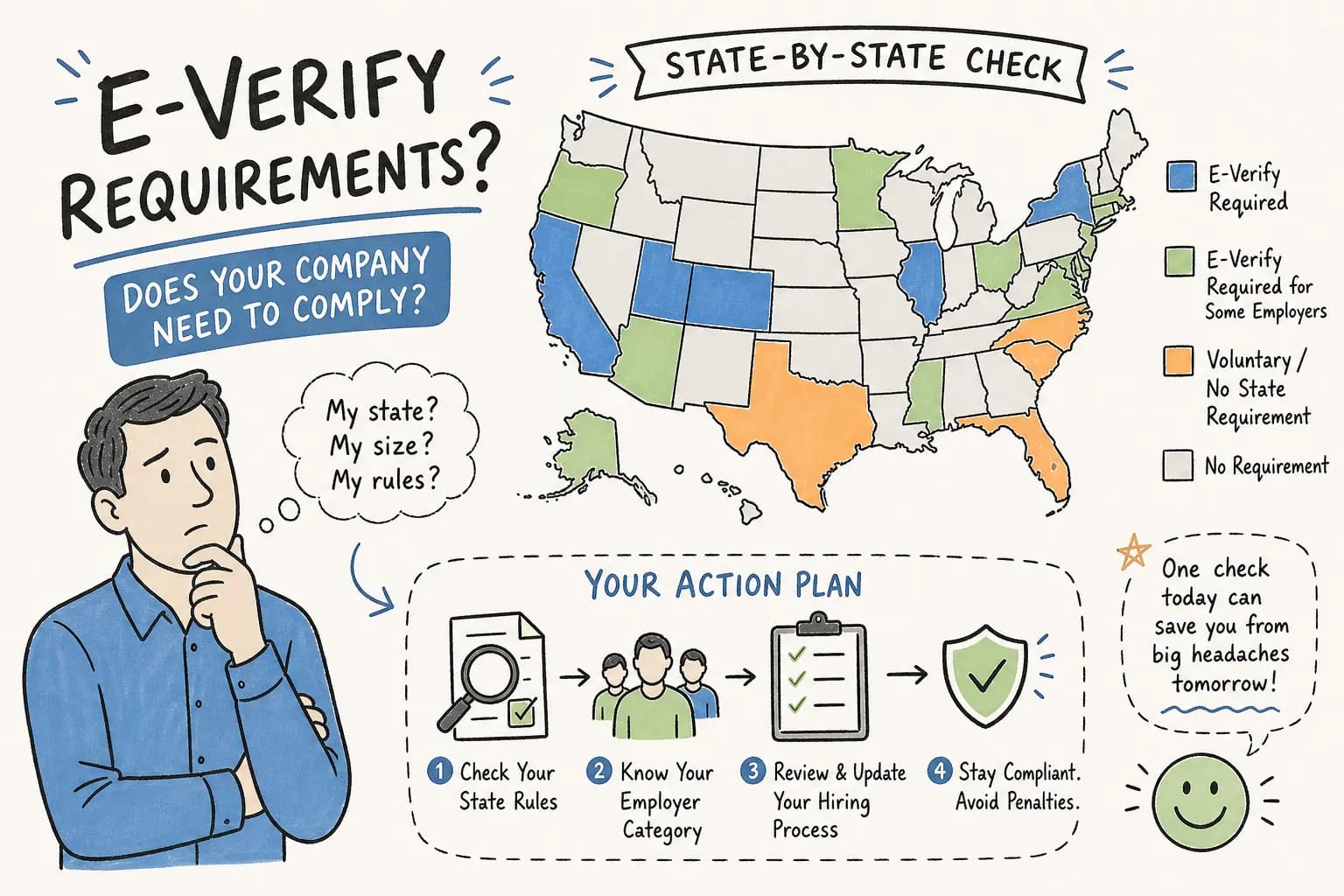
The seven states at a glance
| State | Who must use it | Threshold | Authority |
|---|---|---|---|
| Arizona | Every licensed employer | None | A.R.S. § 23-214 |
| Florida | Private employers 25+; public employers and their contractors | 25 (private) | Fla. Stat. § 448.095 |
| Utah | Private employers 150+ — E-Verify is one option of several | 150 | Utah Code § 13-47-201 |
| Pennsylvania | All construction industry employers — not just public works | 1 employee | Act 75 of 2019, 43 P.S. § 168.1 et seq. |
| Pennsylvania | Public works contractors and subcontractors (separate, narrower duty) | Projects over $25,000 | Act 141 of 2022, Art. XXIV-C |
| Texas | State agencies; executive-agency service contractors | n/a | Gov't Code ch. 673; Exec. Order RP-80 |
| Nevada | No one | — | No statute |
| California | No one — and misuse is penalized | — | Lab. Code § 2814 |
Arizona: no size threshold at all
Arizona is the strictest of the seven and has been since 2008. A.R.S. § 23-214(A) reads: "After December 31, 2007, every employer, after hiring an employee, shall verify the employment eligibility of the employee through the e-verify program and shall keep a record of the verification for the duration of the employee's employment or at least three years, whichever is longer."
A two-person shop in Flagstaff is covered on the same terms as a thousand-employee manufacturer. The only limit is definitional: A.R.S. § 23-211 reaches an employer that transacts business in Arizona, "has a license issued by an agency in this state," and employs one or more people there. That state-license element is what the enforcement scheme hangs on.
The teeth are next door. A.R.S. § 23-212 makes it unlawful to knowingly employ an unauthorized worker and authorizes suspension and revocation of the business's licenses. Subsection (I) is the incentive to run the checks properly: proof of verifying employment authorization through E-Verify "creates a rebuttable presumption that an employer did not knowingly employ an unauthorized alien."
Florida: the 2021 date is the wrong one
If your compliance file says Florida's private-employer mandate took effect January 1, 2021, it is describing a regime that no longer exists.
The rule now in force is Fla. Stat. § 448.095(2)(b): "Beginning on July 1, 2023, a private employer with 25 or more employees shall use the E-Verify system to verify a new employee's employment eligibility." That language arrived with SB 1718, chapter 2023-40. Verification is due within three business days of the first day worked, records are kept at least three years, and if E-Verify is unavailable for three business days the employer uses the I-9 and documents the outage.
The January 2021 date belongs to the predecessor statute, SB 664 (chapter 2020-149) — broader in reach, softer in method. It applied to every private employer with no size threshold, and let the employer choose between E-Verify and simply retaining copies of the verification documents for three years. The 2023 rewrite narrowed coverage to 25 or more and removed the choice. The statute's history line preserves the sequence: "s. 2, ch. 2020-149; s. 7, ch. 2023-40; s. 218, ch. 2024-6."
Enforcement escalates. Since July 1, 2024, the Department of Commerce must notify a noncompliant employer and allow 30 days to cure (§ 448.095(6)(a)). On a third determined failure in any 24-month period it "must impose a fine of $1,000 per day" until the noncompliance is proved cured, and the noncompliance grounds suspension of all licenses issued by a chapter 120 licensing agency (§ 448.095(6)(b)).
Utah: a verification mandate, not an E-Verify mandate
Utah is the state most often misdescribed, because the shorthand "Utah requires E-Verify at 150 employees" drops the part that matters. Utah Code § 13-47-201 says a private employer who employs 150 or more employees on or after May 4, 2022, may not hire a new employee unless it is registered with, and uses, "a status verification system." The definition in § 13-47-102(4) is deliberately plural: E-Verify, a federal equivalent designated by DHS, the Social Security Number Verification Service, or "an independent third-party system with an equal or higher degree of reliability" as those programs. E-Verify satisfies the statute; so do the alternatives. An employer told it has no option but E-Verify has been told something the statute does not say.
Employers of H-2A and H-2B visa holders they sponsor are excepted (§ 13-47-201(2)), and a complying employer gets a shield from state-law civil liability for the hire and for a refusal to hire (§ 13-47-202). One caution: every section of chapter 47 carries the heading "(Contingently Repealed)," and a contingent repeal reads identically to a permanent provision. The section states its own terms: it "is repealed on the earlier of July 1, 2027, or 120 days after the day on which the governor makes the finding described in Subsection 63G-12-202(3)(a)." Nothing in the operative text signals that, which is exactly why the date is worth carrying. The 2026 session took two runs at this and neither landed. HB 294, "Employer Verification Amendments," would have moved the threshold to 125 employees effective July 1, 2027; HB 386, "Immigration Amendments," would have struck the scheduled repeal outright. Both show the same last action — filed 3/6/2026 to the "House file for bills not passed." So the 150-employee threshold stands, and so does the repeal date: the bill that would have removed it is the one that died. The threshold has moved before, too — the 2010 enactment applied at 15. Confirm both on le.utah.gov first.
Pennsylvania: two mandates, and the broad one is the one that gets missed
Pennsylvania is the state most likely to be summarised wrongly, because it has two E-Verify statutes and the narrower one is the famous one. Start with the broader.
The Construction Industry Employee Verification Act (Act 75 of 2019, 43 P.S. § 168.1 et seq.) requires every construction industry employer in Pennsylvania to run new hires through E-Verify. Not public works contractors — everyone in construction. The Act defines a construction industry employer as one that “transacts business in this Commonwealth” and “employs at least one employee” in it, and expressly includes “a staffing agency that supplies workers to a construction industry employer.” The employer “shall verify the employment eligibility of the employee through the E-Verify program and shall keep a record of the verification for the duration of the employee’s employment or three years, whichever is longer.” A first violation draws a warning letter. The Act took effect one year after enactment; PA Labor & Industry puts the date at October 7, 2020 and states flatly that “all employers in the construction industry in Pennsylvania will be required to use E-Verify.” If you run a two-person private drywall business in Pennsylvania, this reaches you.
The second statute is the one the handbooks cite, and its citation is dead. The Public Works Employment Verification Act, Act 127 of 2012, was repealed and re-enacted as Article XXIV-C of the Administrative Code of 1929 (71 P.S. §§ 656.1—656.11) by Act 141 of 2022, signed November 3, 2022 and effective for these purposes July 22, 2023.
The substance survived the move. Under the Department of General Services' statement of policy, a public works contractor or subcontractor must run each new employee through E-Verify within five business days of the start date, and a signed verification form is a precondition of award. "Public work" means construction, reconstruction, demolition, alteration or repair other than maintenance, publicly funded in whole or part, where estimated project cost exceeds $25,000. The compliance office runs random audits and investigates complaints.
Sanctions climb a ladder: a warning letter posted on the department's website for a first violation, 60 calendar days of debarment for a second, one to two years for a third or later, three years for a willful violation determined by a court. Failing to file the form, or falsifying it, is separate — a civil penalty of not less than $2,500 and not more than $25,000 per violation.
Texas: state agencies, and a citation that does not exist
Texas has no private-employer E-Verify mandate, and the duties that exist are narrow. Government Code § 673.002, added by SB 374 in 2015, provides that "a state agency shall register and participate in the E-verify program to verify information of all new employees." Executive Order RP-80, issued December 3, 2014, separately directs agencies under the governor's direction to use E-Verify for their own employees and for contractors and subcontractors on services contracts — a contractor duty the statute does not address, as TxDOT set out in its 2015 request for an Attorney General opinion.
Watch for a bad citation in circulation. Government Code chapter 2264 is frequently named as Texas's E-Verify chapter. It is not: it is titled "Restrictions on Use of Certain Public Subsidies" and contains no E-Verify provision at all. The confusion may trace to SB 1621 in 2023, which would have reached state contractors, political subdivisions and private employers. It died: last action May 21, 2023, "not again placed on intent calendar."
Nevada: no mandate, and NRS 613.440 is not the statute
Nevada requires no employer to use E-Verify. This error deserves a specific correction, because it circulates with a citation attached, which makes it look verified: NRS 613.440 is routinely called Nevada's E-Verify statute. It is not. NRS 613.440 is the definitions section of the article headed "Use of Lie Detectors," defining "lie detector" as a polygraph, voice stress analyzer or similar device for NRS 613.440 through 613.510. Chapter 613 carries no E-Verify provision, and neither does chapter 338 (public works) or chapter 333 (state purchasing). Nevada employers still complete the I-9, and may enroll voluntarily.
California: the rule runs the other way
California's rule surprises people because it restricts the employer rather than requiring anything. Under Labor Code § 2814, added by AB 622 in 2015, it is unlawful — except as required by federal law or as a condition of federal funds — for an employer to use E-Verify on an existing employee, or on an applicant who has not received an offer of employment, at a time or in a manner not required by federal law and not authorized by a federal memorandum of understanding. An applicant holding an offer falls outside the prohibition. Your current workforce, and applicants you are still screening, do not.
The section also requires the employer to furnish the worker, as soon as practicable, any notification it receives from the Social Security Administration or DHS containing information specific to that person's E-Verify case. The penalty is not nominal: up to $10,000, and "[e]ach unlawful use of the E-Verify system on an employee or applicant constitutes a separate violation."
Hiring across more than one of these states
- Coverage follows the worksite. An Arizona hire triggers the Arizona rule no matter where payroll or HR sits.
- Count under the statute's own definition. Florida's "employee" excludes independent contractors and casual labor performed entirely within a private residence; Utah counts individuals to whom the employer provides a federal income-reporting form for services performed in Utah. Crossing 25 or 150 on an internal headcount report is not the same as crossing it under the statute — the threshold table cross-checks it.
- Do not run existing employees through E-Verify to catch up. California prohibits it outright and prices each instance separately. Elsewhere, what a non-contractor employer may do with its existing workforce is governed by the E-Verify memorandum of understanding, not by statute — read the current MOU. The FAR contractor rule is the narrow exception.
- Apply it consistently. Florida, Utah and Pennsylvania each carry a nondiscrimination command in the verification statute itself. Verifying selectively is its own violation, whether or not the mandate applied.
For a question that turns on your own headcount, state and hire date, the assistant answers with the governing citation attached; the guides for Arizona, Florida and Utah go deeper.
This article is general information, not legal advice. Verify every figure against the primary source before making a compliance decision, and take fact-specific questions to an employment attorney licensed in your state.
Need this for a specific state?
This article covers the process. The assistant answers a specific question about a specific state with the governing statute attached, across California, Nevada, Texas, Pennsylvania, Arizona, Utah and Florida.
Ask the HR assistantGeneral information, not legal advice. Employment law varies by state and locality and changes over time — confirm against the governing statute before acting on it.