
New-hire reporting compared: deadlines, extra fields and penalties in seven states
10 min read · Published September 4, 2026
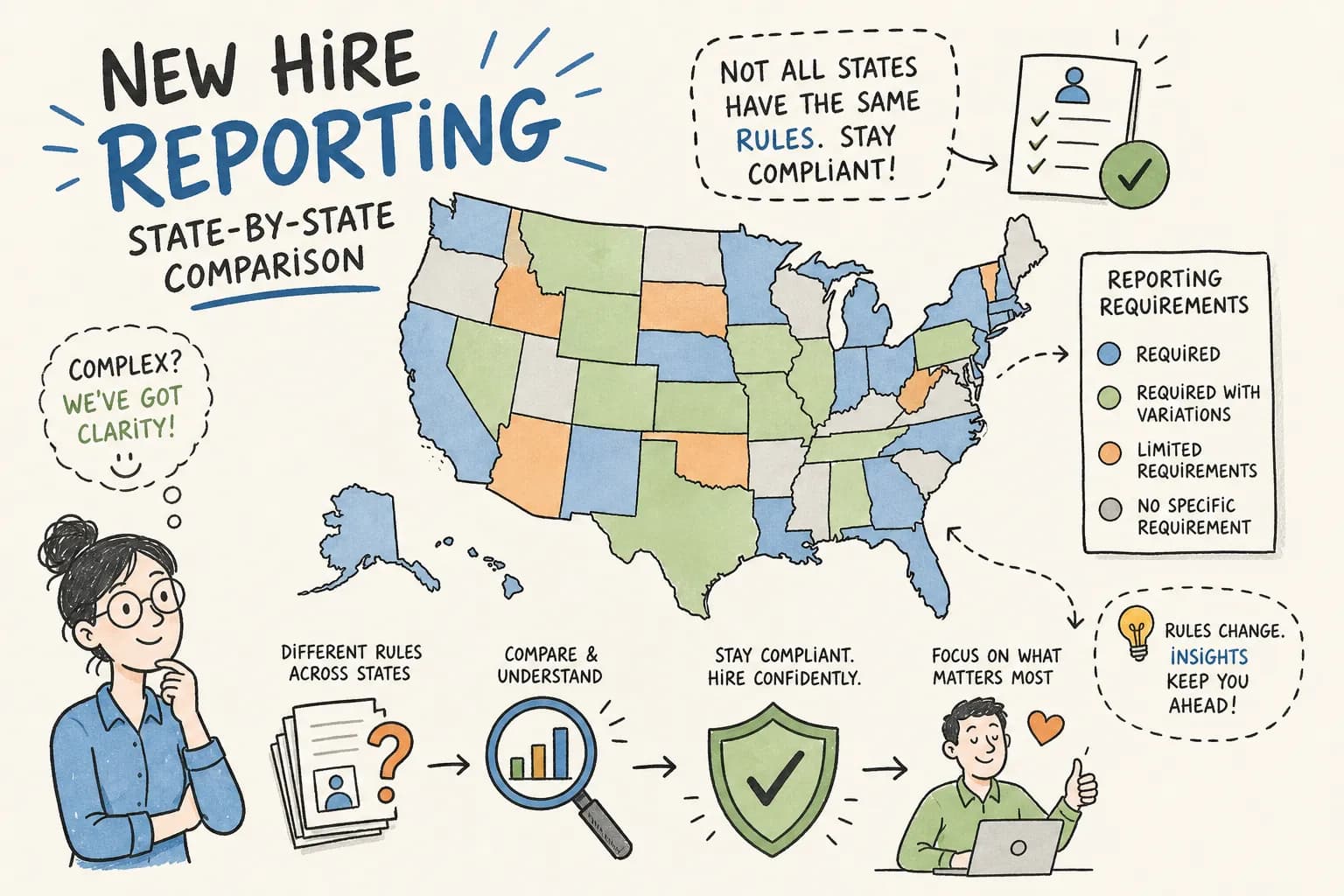
Payroll runs the new-hire batch on the fifteenth. Six names go in, among them a Pennsylvania employee back after six weeks off, an Arizona employee returning from unpaid leave, and a Texas courier who signed on through the company's delivery app and has never met a manager. Everyone can recite the rule — report within twenty days — and the batch clears it comfortably. Three of those six are still reporting problems, and none of them is a late filing.
New-hire reporting reads like the most mechanical duty in HR: a few fields, one deadline, one file. It is also handled from memory rather than from the statute, so the errors cluster in four places — who counts as a new hire, who counts as an employee, which fields a state adds, and what happens if you miss.
The federal floor is a ceiling with a side door
42 U.S.C. § 653a requires seven data points for each newly hired employee: the employee's name, address and Social Security number; the date services for remuneration were first performed; and the employer's name, address and IRS employer identification number. Three features of it drive everything below.
Twenty days is a maximum for states, not a fixed rule for employers. Section 653a(b)(2) lets each state set the time within that outer bound — day 20 "or such earlier date as may be required by State law" — and gives electronic and magnetic filers a real alternative: two monthly transmissions "not less than 12 days nor more than 16 days apart." A report on a semimonthly cycle can legitimately land more than twenty days after a hire, so an audit that flags everything past day 20 as late produces false positives.
A rehire becomes a new hire after sixty days. Section 653a(a)(2)(C) defines "newly hired employee" to include someone previously employed "but has been separated from such prior employment for at least 60 consecutive days." That benchmark is what the state rules diverge from — in both directions.
The penalty is optional, and small. Section 653a(d) gives states "the option" to set a civil money penalty not exceeding $25 per failure, or $500 where employer and employee conspired. Two of the seven below never took it.
Seven states, side by side
| Jurisdiction | Deadline | Reportable rehire | Beyond the federal seven fields | Penalty, as the statute writes it |
|---|---|---|---|---|
| Federal floor (§ 653a) | 20 days, or two monthly transmissions 12–16 days apart if filed electronically | Separated 60+ consecutive days | — | State option only: up to $25; $500 for conspiracy |
| Arizona (A.R.S. § 23-722.01) | 20 days; electronic filers twice monthly, no more than 16 days apart | Rehire or return to work after layoff, furlough, separation, unpaid leave or termination — no minimum gap | — | None on employers. (K) bars them; (G)'s $1,000 runs against a state employee or agent who leaks the data |
| California (UIC § 1088.5) | 20 days; electronic filers 12–16 days apart | Separated 60+ consecutive days | State employer identification number if one has been issued (its "first date the employee worked" is the federal seventh) | May assess $24 per failure unless due to good cause; $490 for conspiracy |
| Florida (Fla. Stat. § 409.2576) | 20 days; electronic filers 12–16 days apart | "Newly hired or rehired," never defined — no gap on its face | Optional date of birth; separate report for non-employees paid $600+ a year | None in the section's nine subsections |
| Nevada (NRS 606.120) | Tracks federal automatically: "within the time prescribed in 42 U.S.C. § 653a" | Federal definition, by reference | — | Division may adopt by regulation a penalty of less than $25 — none adopted |
| Pennsylvania (23 Pa.C.S. §§ 4391–4396) | 20 days; electronic filers 12–16 days apart | Laid off, furloughed, separated or on leave without pay more than 30 days, or terminated | Name and telephone number of an employer contact | Written warning first, then up to $25 per later violation; $500 for conspiracy |
| Texas (Tex. Fam. Code ch. 234) | Incorporates § 653a by reference (§ 234.102) | Separated or no earnings from the employer for 60+ consecutive days | — | Up to $25/$500, only where the employer knowingly violates a procedure; the attorney general sues |
| Utah (Utah Code ch. 35A-7) | 20 days; 12–16 day semimonthly filing only if the department approves | Separated 60+ consecutive days | — | $25 per failure; $500 where the failure is intentional and by agreement with the employee |
Pennsylvania is stricter than federal law, in two ways at once
Pennsylvania is the state most likely to be missed by an otherwise compliant multistate process: it breaks the assumption that a state either matches the federal rule or goes easier.
First, its definition of "newly hired employee" reaches a rehired former employee who was "laid off, furloughed, separated or granted leave without pay for more than 30 days," or who was terminated (23 Pa.C.S. § 4391). The returning employee in the opening paragraph — six weeks out, back on the payroll — is reportable in Pennsylvania and would not be under the federal definition. A system keyed to sixty days silently drops every Pennsylvania rehire in the 31-to-59-day window.
Second, Pennsylvania requires an eighth field. Section 4392(b) lists the federal seven and adds "the name and telephone number of an employer contact," which the statute lets you attach to the W-4 rather than file on a state form. A bare W-4 that satisfies the other six states is one element short here. The penalty under § 4396 begins with a written warning, then runs up to $25 for each later violation, and up to $500 where the failure or a false report results from a conspiracy between employer and employee.
Arizona: no floor on returns, and a website that contradicts the statute
A.R.S. § 23-722.01(A)(2) requires a report on "the rehiring or returning to work of any employee who was laid off, furloughed, separated, granted a leave without pay or terminated from employment." There is no minimum gap: a return from a two-week unpaid leave is reportable. Subsection (D) also drops the federal 12-day floor for electronic filers, requiring "two monthly transmissions not more than sixteen days apart."
Then the enforcement picture inverts. Subsection (K) reads: "This section does not allow the department to impose penalties on employers for failing to comply with this section's reporting requirements." The $1,000 penalty in subsection (G) targets a state employee or agent who discloses the collected data without authorization, not an employer who files late.
That matters, because the Arizona New Hire Reporting Center's own site says something different. Its Compliance and Penalties page — retrieved September 4, 2026 — states that the fine "can be up to $25 per newly hired employee, and can be increased up to $500 if employer and employee conspire to avoid reporting." On an Arizona-branded page that reads as Arizona's penalty; the statute says the department may not impose one. Pages get rewritten, so treat that as a dated snapshot — and read the statute either way, because the real Arizona exposure was never the fine. It is the return-to-work trigger.
Texas: a definition problem, not a deadline problem
Texas takes its deadline straight from federal law — § 234.102 directs employers to report each newly hired or rehired employee "in accordance with the requirements of 42 U.S.C. Section 653a." The Texas-specific work sits in § 234.101(1), which defines "employee" to include "an independent contractor as defined by the Internal Revenue Service," then names two categories outright: a driver who logs in to the digital network of a transportation network company, "regardless of whether the driver is considered an independent contractor," and an individual who logs in to or otherwise uses a technology platform to make deliveries for compensation. Added by H.B. 458, effective September 1, 2021.
The courier above is reportable in Texas. The rehire trigger is wider too — separated or "has not received earnings from the employer for at least 60 consecutive days" — so an on-call worker who earned nothing for two months becomes reportable again on the next assignment. Enforcement, by contrast, is narrow: § 234.105(a) reaches only an employer who "knowingly violates" a reporting procedure.
The second report: independent contractors in California and Florida
Two of these states require a filing for people who are not employees at all — the report most often missed, because onboarding never triggers it.
California's UIC § 1088.8 requires a service-recipient to report a service-provider within 20 days of the earlier of first making payments aggregating $600 in a year, or entering a contract providing for $600 or more — on form DE 542, which also asks for the contract's total amount and expiration date. The penalties mirror § 1088.5: $24, or $490 for conspiracy, unless the failure is due to good cause.
Florida's § 409.2576(3)(b) puts the same duty on a "service recipient" paying a non-employee $600 or more per calendar year, due within 20 days after the earlier of the first qualifying payment or the date the contract is entered into. That differs from Florida's employee rule, which runs from the hire date: a signed contract starts the clock before any money moves.
Penalties on paper versus penalties in force
Nevada is the clearest case. NRS 606.120(3) says the Division "may adopt by regulation a civil penalty of less than $25" — less than, not up to — imposed only after notice and an opportunity for a hearing. No such regulation exists: the Nevada Administrative Code has no chapter 606 at all. The duty itself binds fully, because subsection (1) imports § 653a wholesale.
Utah went the other way. Section 35A-7-106(1) sets $25 for each failure, or $500 where the failure "is intentional and is the result of an agreement between the employer and the employee" — both conditions, not either. Utah also gates the filing schedule as no other state here does: semimonthly 12-to-16-day filing is available only "if approved by the department" (§ 35A-7-104(2)(b)). An employer that rolls a semimonthly cycle out nationally, unapproved in Utah, is filing late there on a schedule of its own making.
What this changes in practice
- Set the rehire threshold per state, not globally. Thirty days in Pennsylvania; sixty in California, Texas and Utah; none in Arizona; unstated in Florida's section.
- Add a return-to-work trigger, not just a hire trigger. Arizona counts a return from unpaid leave, Texas a sixty-day earnings gap. Neither creates an onboarding record in most systems.
- Decide whether contractors are in scope. Texas folds them into the employee report; California and Florida require a separate one at $600.
- Confirm the field list state by state. Pennsylvania's employer contact, and California's conditional state employer identification number, sit on top of the federal seven.
- Verify your filing cycle is permitted where you use it. Utah requires approval for semimonthly filing; Arizona has no 12-day floor.
For a specific hire in a specific state, the assistant answers with citations to the governing provision, and the per-state guides under resources cover the surrounding obligations — starting points for verification, not substitutes for the section itself.
This article is general information, not legal advice. Verify every figure against the primary source before making a compliance decision, and take fact-specific questions to an employment attorney licensed in your state.
Need this for a specific state?
This article covers the process. The assistant answers a specific question about a specific state with the governing statute attached, across California, Nevada, Texas, Pennsylvania, Arizona, Utah and Florida.
Ask the HR assistantGeneral information, not legal advice. Employment law varies by state and locality and changes over time — confirm against the governing statute before acting on it.