
How non-compete enforceability differs across California, Nevada, Texas, Pennsylvania, Arizona, Utah and Florida
11 min read · Published September 3, 2026
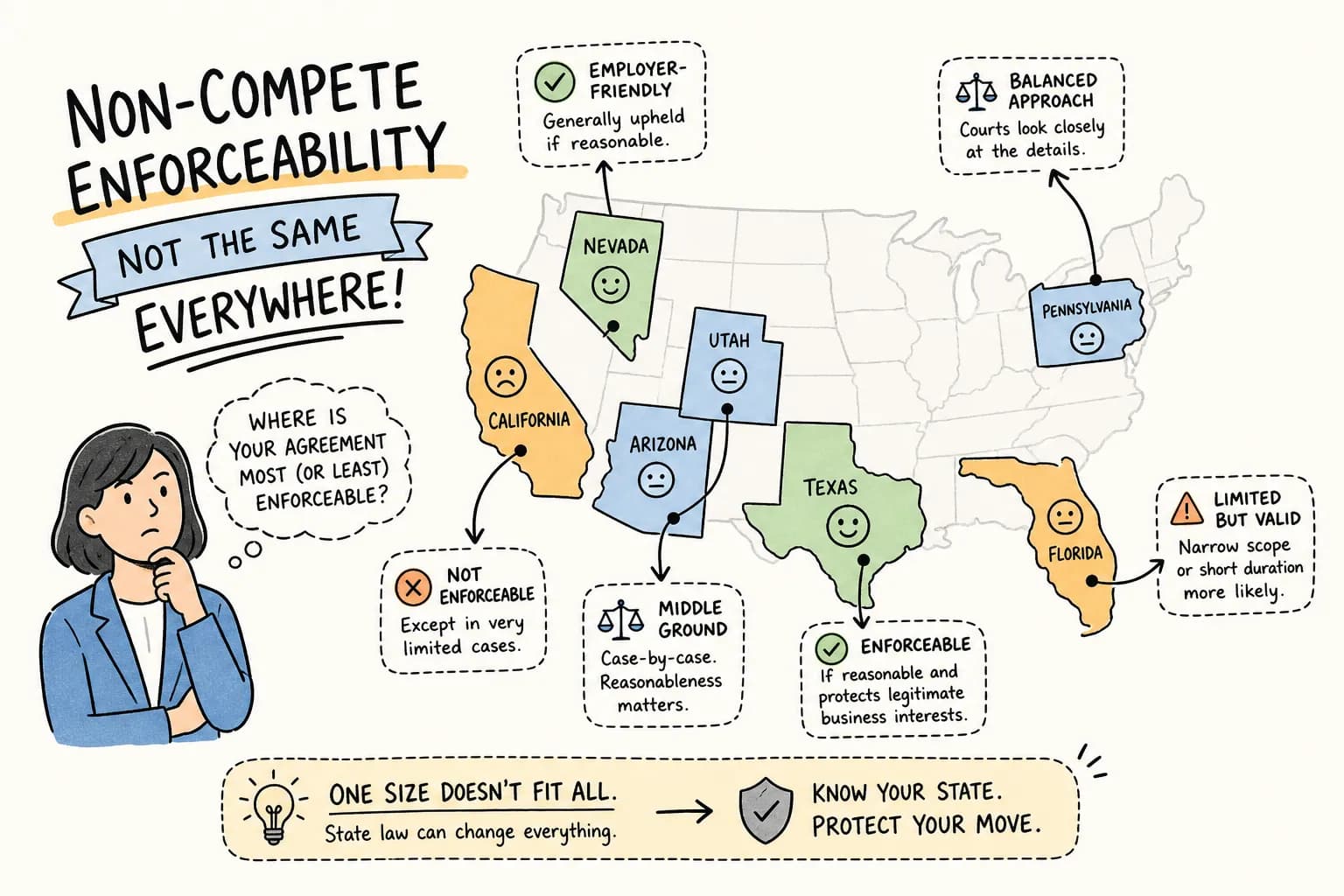
An employer with sixty people spread across five states asks HR to standardise the paperwork: one offer packet, one non-compete, twelve months and fifty miles, signed on day one by everyone from the warehouse floor up. The instinct is reasonable. The result is an agreement that is void against a large share of the people who sign it, unlawful to even include in the California contracts, and — in Nevada and Texas — quietly rewritten by a judge into terms the employer never negotiated.
Non-competes are the widest state-law split an HR team will meet. Across the seven states covered here, the same clause runs the full range from automatically void to presumptively enforceable for four years.
The federal rule is gone — state law governs entirely
The FTC's 2024 nationwide ban never took effect. It was set aside in Ryan, LLC v. FTC, 746 F. Supp. 3d 369 (N.D. Tex. Aug. 20, 2024) (docket). The Commission dismissed its appeals in September 2025 and then formally removed 16 C.F.R. part 910 from the Code of Federal Regulations effective February 12, 2026 (91 Fed. Reg. 6507).
Enforceability is now a purely state question. The FTC retains case-by-case authority under Section 5 of the FTC Act, so an aggressive covenant is not wholly beyond federal reach — but there is no federal rule left to read in advance.
Where the seven states land
| State | Baseline | The provision people miss |
|---|---|---|
| California | Void | The ban reaches agreements signed out of state |
| Nevada | Enforceable with statutory limits | Never against an hourly-only employee |
| Texas | Enforceable if ancillary + reasonable | Court reforms rather than strikes |
| Pennsylvania | Enforceable if reasonable + supported | Continued employment is not consideration |
| Arizona | Enforceable, strictly construed | Blue-pencil trims; it will not rewrite |
| Utah | Enforceable, capped at one year | One-way fee-shifting against the employer |
| Florida | Broadly enforceable | Duration presumptions, plus the CHOICE Act |
California: void, and the void travels
Bus. & Prof. Code § 16600(a) voids every contract restraining a person from a lawful profession, trade or business. Subdivision (b)(1) closes the drafting workaround in terms: the section is read broadly to void any noncompete in the employment context "no matter how narrowly tailored." That is why a carefully limited customer non-solicit is not a reliable answer either — narrow tailoring is the defence the statute forecloses. Where a departing employee actually takes protected information, the claim is trade-secret misappropriation, not breach of a covenant.
Two 2024 amendments do different jobs.
Section 16600.1 (AB 1076) is the notice section. It makes including a void noncompete clause unlawful, and required individualised written notice by February 14, 2024 to every current employee and every former employee employed after January 1, 2022 whose contract contained one — sent to both the last known mailing address and the email address. A violation is an unfair-competition act under § 17200.
Section 16600.5 (SB 699) is the separate extraterritorial and enforcement section. A contract void under the chapter is unenforceable regardless of where and when it was signed, and an employer may not attempt to enforce it even where the contract was signed and the employment maintained outside California. Employees, former employees and prospective employees have a private action for injunctive relief, actual damages and attorney's fees. Do not attribute the out-of-state reach to § 16600.1 — that section has no extraterritorial provision.
A third statute answers the clause sitting next to the covenant. Labor Code § 925 makes an out-of-state forum or choice-of-law term voidable at the employee's request, for agreements entered into, modified or extended on or after January 1, 2017, where the employee primarily resides and works in California. The exception that decides most disputes: § 925 does not apply if the employee was individually represented by legal counsel in negotiating that term. Picking Texas or Florida law in a California employee's contract does not import that state's non-compete rules.
Nevada: enforceable, with three limits that decide most cases
NRS 613.195 permits a covenant supported by valuable consideration, no broader than necessary, not an undue hardship, and appropriate to that consideration. Three further subsections do the real work.
Subsection 3 is the one most often misstated: "A noncompetition covenant may not apply to an employee who is paid solely on an hourly wage basis, exclusive of any tips or gratuities." The test is the pay basis, not a wage level — there is no minimum-wage multiple anywhere in this statute, and any checklist telling you to compare an employee's pay to 150 percent of the state minimum wage before applying a covenant has borrowed that figure from a different statute.
Subsection 5 governs layoffs: where the separation results from a reduction of force, reorganization or similar restructuring, the covenant is enforceable only during the period the employer is paying the employee's salary, benefits or equivalent compensation, including severance pay. Stop the payments and the restriction stops with them.
Subsection 6 requires a court that finds the covenant unreasonable to revise it and enforce it as revised. Nevada judges no longer void an overbroad covenant outright — the older result in Golden Road Motor Inn v. Islam, 376 P.3d 151 (Nev. 2016), was superseded by the 2021 amendment, so cite the current statute rather than the case. The Nevada non-compete guide works through the statutory requirements.
Texas: consideration first, then the new health-care regime
Under Bus. & Com. Code § 15.50 a covenant is enforceable only if it is ancillary to or part of an otherwise enforceable agreement and reasonable in time, geographic area and scope of activity. The failure point is the ancillary requirement — the employer must actually give something the restraint protects, such as confidential information, specialised training or equity. Where the terms are overbroad, § 15.51 directs the court to reform them, so an aggressive draft is not self-defeating in the way it would be in Arizona.
SB 1318 changed the health-care picture as of September 1, 2025. A physician covenant must expire no later than the one-year anniversary of the date the contract or employment terminated, must limit the geographic area to no more than a five-mile radius from the location at which the physician primarily practiced, must state its terms clearly and conspicuously in writing, and must provide a buyout in an amount not greater than the physician's total annual salary and wages at termination. It is also void where the physician is discharged without good cause. A new § 15.501 extends the same expiration, geographic and buyout limits to dentists, professional and vocational nurses, and physician assistants.
The applicability clause is what most summaries drop: the limits reach only a covenant entered into or renewed on or after September 1, 2025. An existing agreement stays under prior law until renewal — which makes renewal, not the effective date, the moment to redraft.
Pennsylvania: consideration is where these fail
Pennsylvania enforces a covenant that is ancillary to employment and reasonable in duration, geography and scope, and its courts will blue-pencil. The recurring defect is timing. In Socko v. Mid-Atlantic Systems of CPA, Inc., 633 Pa. 555, 126 A.3d 1266 (Pa. 2015), the Pennsylvania Supreme Court held that continued employment alone is not adequate consideration for a covenant signed after hire, and that a Uniform Written Obligations Act recital does not cure the gap. A covenant added mid-employment needs something new and valuable attached to it — a promotion, a bonus, equity.
Act 74 of 2024, the Fair Contracting for Health Care Practitioners Act, took effect January 1, 2025. Two details are routinely overstated. First, its definition of "health care practitioner" is a closed list of five: medical doctors, doctors of osteopathy, certified registered nurse anesthetists, certified registered nurse practitioners, and physician assistants. It does not reach nurses generally, dentists, pharmacists or therapists. Second, it applies only to a covenant entered into after the effective date; anything signed on or before January 1, 2025 stays under common law. Within its scope a covenant is void as contrary to public policy, with one exception — an employer may enforce a covenant of no more than one year where the practitioner was not dismissed by the employer.
Arizona, Utah and Florida
Arizona has no general non-compete statute. Covenants are enforced only where they are no broader than necessary to protect a legitimate business interest, not oppressive to the employee, and not contrary to public policy, and courts construe them against the employer, with heightened scrutiny for physician covenants (Valley Medical Specialists v. Farber, 194 Ariz. 363 (1999)). Arizona's blue pencil strikes offending words; it does not rewrite them. An overbroad Arizona covenant can fail entirely where a Texas one would be reformed.
Utah caps a post-employment non-compete at one year from separation; anything longer is void (Utah Code § 34-51-201). Enforcement carries asymmetric risk: under § 34-51-301, an employer that seeks to enforce a non-compete, nondisclosure or nonsolicitation agreement and loses is liable for the employee's arbitration costs, attorney fees, court costs and actual damages, with no reciprocal award to a prevailing employer. HB 270 (2026) went further, barring post-employment non-competes for healthcare workers and veterinarians on or after May 6, 2026. That one is very new — confirm the text and effective date before relying on it.
Florida runs the other way. Fla. Stat. § 542.335 directs courts to enforce reasonable restrictions, presuming six months or less reasonable against a former employee and more than two years unreasonable. The 2025 CHOICE Act (§§ 542.41–542.45, effective August 15, 2025) layers a stronger regime on top for "covered employees," allowing garden-leave and non-compete agreements up to four years with a presumption of enforceability. Two things are easy to get wrong. The salary test runs on annualised base compensation plus the value of noncash benefits — bonuses, commissions and tips are excluded — measured against twice the annual mean wage of the Florida county where the employer has its principal place of business, or, only where that principal place of business sits outside Florida, the county where the employee resides. Where the employee works is never the county test. And § 542.45 gates the Act twice over: it reaches the agreement only where the covered employee's primary place of work is in Florida, or the employer's principal place of business is in Florida and the agreement expressly selects Florida law — and enforceability is then conditional on written advice of the right to seek counsel, at least seven days with the proposed agreement before the offer expires, and a written acknowledgement that the role carries confidential information or customer relationships. The Florida CHOICE Act guide sets out the covered-employee test.
What actually protects the business
Three instruments do more work than the non-compete in all seven states, California included.
Non-solicitation of customers and employees. Narrower, easier to justify, and enforceable in six of the seven. In California, treat it as unreliable and rely on trade-secret law instead; in Utah, remember that a nonsolicitation agreement carries the same § 34-51-301 fee exposure as a non-compete.
Confidentiality and trade-secret protection. This is the durable one: it does not depend on a restraint of trade, is not capped at one year, and survives in California, where the covenant does not. It is only as good as the underlying hygiene — defined categories of confidential information, access controls, exit interviews, and device and account recovery on the last day.
Garden leave. Paying through a notice period buys the same competitive gap without asking a court to restrain anyone. Florida's CHOICE Act builds it in expressly, and Nevada's subsection 5 effectively requires it after a reduction in force.
What to do
Stop maintaining one template. Sort your covenants by the employee's work state, then by signing date — the Texas and Pennsylvania health-care rules and California's out-of-state reach all turn on when the document was signed, not on when you are reading it. Confirm there is real consideration behind every mid-employment covenant, strip covenants out of the California packets entirely, check the pay basis before applying one in Nevada, and move the protection you actually need into confidentiality and non-solicitation terms. When a specific agreement is in front of you, the assistant will cite the controlling section for the state you name.
This article is general information, not legal advice. Verify every figure against the primary source before making a compliance decision, and take fact-specific questions to an employment attorney licensed in your state.
Need this for a specific state?
This article covers the process. The assistant answers a specific question about a specific state with the governing statute attached, across California, Nevada, Texas, Pennsylvania, Arizona, Utah and Florida.
Ask the HR assistantGeneral information, not legal advice. Employment law varies by state and locality and changes over time — confirm against the governing statute before acting on it.