
How each state’s overtime rules compare to the FLSA: California, Nevada, Texas, Pennsylvania, Arizona, Utah and Florida
10 min read · Published September 3, 2026
A payroll administrator at a company with sites in four states sets up one overtime rule: time and a half after forty hours in the workweek, nothing before that. It runs clean for most of the workforce. Then a warehouse lead in Sacramento works eleven hours on a Tuesday and thirty-nine hours for the week. A housekeeper in Reno earning $16.50 an hour works nine hours on a Thursday and thirty-four hours for the week. Both were underpaid — and neither underpayment appears anywhere in a weekly-hours report, because neither employee crossed forty.
That is the entire problem in one paragraph. The Fair Labor Standards Act is a floor, not a ceiling: a state may pile obligations on top of it but may never go below it, and two of the seven states covered here build a second story.
The short answer
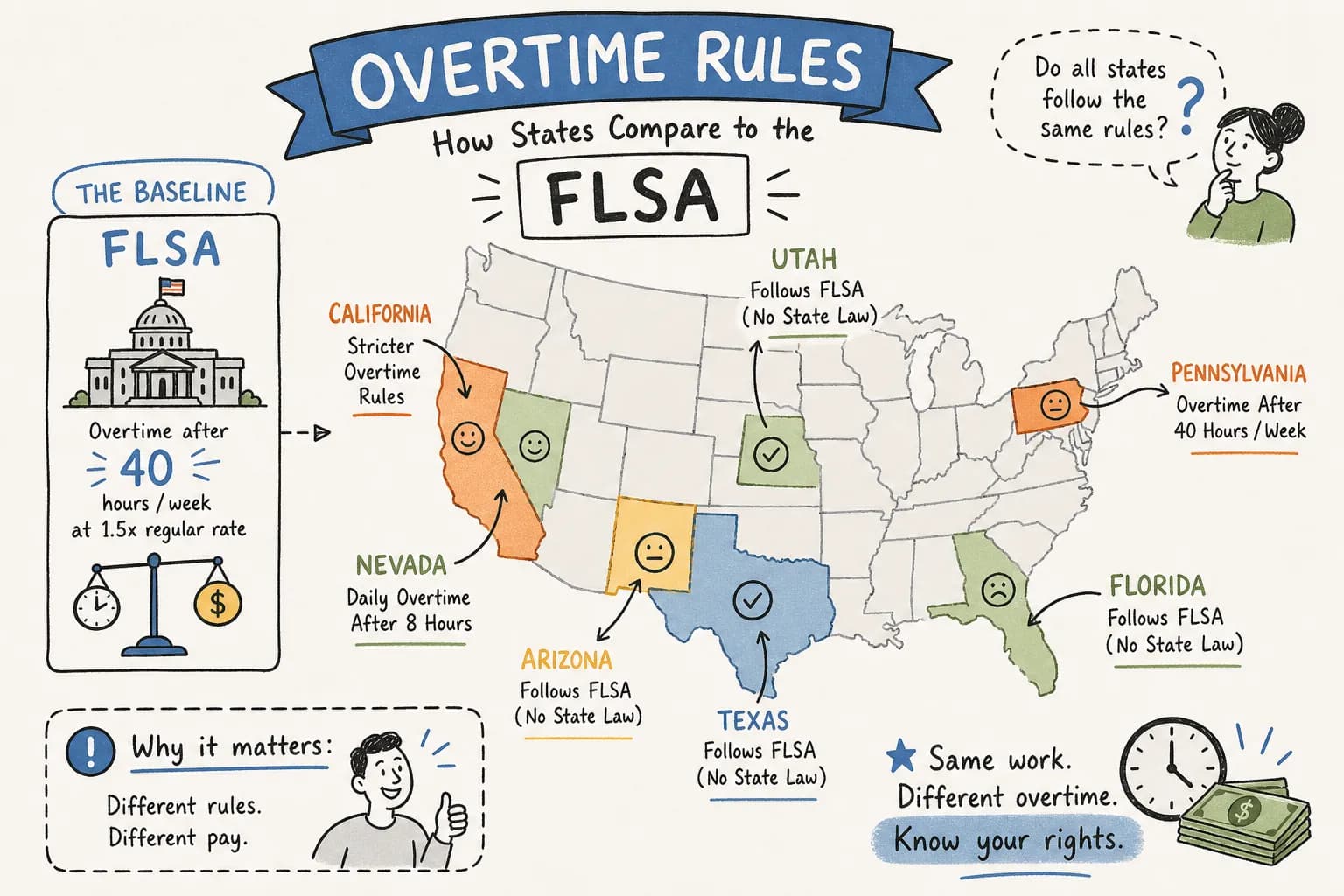
Of California, Nevada, Texas, Pennsylvania, Arizona, Utah and Florida, only California and Nevada impose overtime obligations that reach beyond the FLSA. The other five leave the overtime trigger to federal law: 1.5× the regular rate after 40 hours in a workweek, with no daily overtime, no double time and no seventh-day premium.
That does not make the other five identical to each other — minimum wage, wage-payment timing and the arithmetic of the regular rate all still differ. But if you are asking "does this state make me pay overtime the FLSA would not," the answer is California and Nevada, and nowhere else on this list.
What the federal floor actually requires right now
Overtime under 29 U.S.C. § 207 is 1.5× the regular rate for hours over 40 in a workweek. There is no federal daily overtime. The federal minimum wage is $7.25.
The exempt salary thresholds are worth stating precisely, because a lot of 2024-vintage advice is still circulating. The white-collar salary level is $684 per week ($35,568 a year) (29 C.F.R. § 541.600), the highly compensated employee threshold is $107,432 (§ 541.601), and the computer-employee alternative is $27.63 an hour (§ 541.400).
The posture matters. The Department of Labor's 2024 rule would have raised the salary level to $844 and then $1,128 a week; it was vacated nationwide in State of Texas v. U.S. Dep't of Labor, 756 F. Supp. 3d 361 (E.D. Tex. 2024). DOL then republished the pre-2024 levels by technical amendment, 91 Fed. Reg. 27833 (May 15, 2026). So $684 is the current number, and it is the number the regulation now prints. If your classification file still says $1,128, it is wrong in the employee's favor — but it is still wrong.
Remember that a salary level is necessary, not sufficient. The duties test has to be satisfied too, and no state on this list changes that.
California: a daily clock, a double-time clock, and a seventh day
California is the outlier by a wide margin. Under Labor Code § 510, a non-exempt employee earns:
- 1.5× after 8 hours in a workday, and after 40 hours in a workweek;
- 2× (double time) after 12 hours in a workday;
- on the seventh consecutive day of work in one workweek, 1.5× for the first 8 hours and 2× beyond 8 hours that day.
The seventh-day rule is the one that gets missed, and the mechanic is specific: the count runs inside your fixed, designated workweek. Seven consecutive shifts that straddle two workweeks do not trigger it. Employees on a validly adopted alternative workweek schedule — a 4/10, for instance — follow modified daily rules rather than none at all, earning 1.5× past their scheduled hours and still double time past 12 hours in a day (Labor Code § 511).
Paying the seventh-day premium also does not make the schedule lawful. Labor Code § 551 entitles every employee to one day's rest in seven, and Labor Code § 552 forbids an employer from causing an employee to work more than six days in seven. Construing those sections in Mendoza v. Nordstrom, Inc. (2017) 2 Cal.5th 1074, the California Supreme Court held that an employee may knowingly give up that day but the employer may not induce it — which in practice means telling employees the entitlement exists and then staying neutral about whether they use it. Overtime pay and the day-of-rest duty are two separate obligations, and satisfying one does not answer the other. The state overtime guide walks through the interaction.
The exempt salary line is a different number in California
California ties the white-collar exemption to a multiple of its own minimum wage rather than to a fixed dollar figure. Under Labor Code § 515, an exempt employee must earn a monthly salary of at least twice the state minimum wage for full-time employment. At the 2026 state minimum wage of $16.90 (Labor Code § 1182.12), that is:
2 × $16.90 × 40 hours = $1,352 per week = $70,304 per year
That is very nearly double the federal $35,568, and it rises every time the state minimum wage does. A salary that clears the federal line by a comfortable margin can still be under the California line. See the DLSE overtime guidance for the agency's own treatment.
Nevada: two tracks, keyed to the employee's own wage
Nevada's rule under NRS 608.018 is the most misread provision in this set, because whether daily overtime applies depends on what the individual employee earns:
- An employee earning less than 1.5× the minimum wage gets 1.5× for hours over 8 hours worked in any 24-hour period, and for hours over 40 in a scheduled workweek.
- An employee earning 1.5× the minimum wage or more gets overtime only after 40 hours in the week.
The cutoff is a formula, not an administratively announced number. Nevada's minimum wage is $12.00 (Nev. Const. art. 15, § 16), so 1.5× is $18.00 an hour today — and that figure moves automatically whenever the minimum wage moves. Do not hard-code $18.00 into a policy document; write the multiplier.
Two mechanics round this out. First, NRS 608.0126 defines the workday as the 24 consecutive hours beginning when that employee starts work, so a window opened by an early shift can capture hours from a later one — which is why the trigger is 8 hours worked in any 24-hour period rather than 8 hours in a calendar day. Second, there is a mutual-agreement exception: no daily overtime is owed where, by mutual agreement, the employee works a scheduled 10 hours a day for 4 calendar days in the week. NRS 608.018(3) then lists Nevada's own exemptions, which do not track the FLSA's — and switching off Nevada's rules leaves the federal ones standing, so a small employer that reads the Nevada exemption alone and concludes it owes no overtime at all is usually wrong. The Nevada overtime guide covers the exemption list; the Office of the Labor Commissioner publishes the current wage bulletins.
The other five: FLSA-only on the trigger, with two narrow qualifications
Texas adopts the federal minimum wage and preempts local minimum wages (Tex. Labor Code ch. 62); overtime is entirely federal, and wage payment runs through the Texas Payday Law. Utah has no state overtime statute, and its minimum wage is the federal $7.25 — but quote the mechanism rather than the printed figure, because Utah Code § 34-40-103 still carries the original $3.35 and $3.80 rates in subsection (1); subsection (2)(a) lets the Labor Commission set the rate by rule (Utah Admin. Code R610-1), and subsection (2)(b) bars a state rate above the federal minimum. Arizona has no overtime statute either — but its minimum wage is $15.15 in 2026, indexed to CPI (A.R.S. § 23-363), with Flagstaff and Tucson higher still.
Correcting a common error: Pennsylvania and Utah are both at $7.25. Only Arizona among those three sits above the federal wage. Pennsylvania's rate is set by 43 P.S. § 333.104 and has not moved since 2009.
Two qualifications keep this from being a clean sweep. Pennsylvania has its own overtime statute, and while the trigger is the federal one — weekly only — the math is not, and it comes from two separate authorities. In Chevalier v. General Nutrition Centers, Inc., 220 A.3d 1038 (Pa. 2019), the Pennsylvania Supreme Court held that the FLSA's fluctuating-workweek half-time multiplier is unavailable under the PMWA, so hours over 40 carry a full 1.5× premium rather than 0.5× — but the court expressly did not decide the divisor. That arrived later by regulation: the regular rate for a salaried non-exempt employee is weekly remuneration divided by 40 (34 Pa. Code § 231.43(g)). Pennsylvania's own higher exempt-salary thresholds were repealed by Act 70 of 2021, so the federal salary level governs there too.
And Florida, whose minimum wage is constitutional and stepping to $15.00 on September 30, 2026 (Fla. Const. art. X, § 24; Fla. Stat. § 448.110), carries one unrepealed oddity at Fla. Stat. § 448.01: ten hours is a legal day's work for a person employed at manual labor, and absent a signed written contract that worker is owed extra pay beyond ten hours in a day.
Seven states against the federal baseline
| Jurisdiction | Daily overtime | Weekly overtime | Other premium | Minimum wage | Exempt salary floor |
|---|---|---|---|---|---|
| FLSA (federal floor) | None | 1.5× over 40 | None | $7.25 | $684/wk ($35,568); HCE $107,432 |
| California | 1.5× over 8; 2× over 12 | 1.5× over 40 | 7th consecutive day in the workweek: 1.5× first 8, 2× beyond | $16.90 (many local rates higher) | $1,352/wk = $70,304/yr (2 × min wage) |
| Nevada | 1.5× over 8 hrs worked in any 24-hour period — only if earning < 1.5× min wage ($18.00); 4×10 mutual-agreement exception | 1.5× over 40 | None | $12.00 (flat, statewide) | No salary test on the face of NRS 608.018(3); the federal test governs FLSA-covered work |
| Texas | None | FLSA only | None | $7.25 (locals preempted) | Federal |
| Pennsylvania | None | 1.5× over 40 (PMWA) | No fluctuating workweek; salaried non-exempt regular rate = salary ÷ 40 | $7.25 | Federal (PA's own higher levels repealed, Act 70 of 2021) |
| Arizona | None | FLSA only | None | $15.15 (CPI-indexed; Flagstaff & Tucson higher) | Federal |
| Utah | None | FLSA only | None | $7.25 (set by rule, not by the figure printed in the statute) | Federal |
| Florida | None generally | FLSA only | Narrow: manual labor beyond 10 hrs/day absent a written contract (§ 448.01) | $14.00, stepping to $15.00 on 9/30/2026 | Federal |
What to do
Configure the timekeeping system by state, not by company. For California, turn on the daily 8-hour and 12-hour thresholds and a seventh-consecutive-day flag scoped to your designated workweek, and re-test the exempt salary list against $70,304 every time the state minimum wage changes. For Nevada, store the daily-overtime eligibility as a comparison — is this employee's rate below 1.5× the current minimum wage — rather than as a fixed $18.00, and document any 4×10 mutual agreement in writing before you rely on it. For the other five, the federal rule governs the trigger, but audit Pennsylvania's salaried non-exempt regular rate and Florida's minimum-wage step-up separately. If you want to pressure-test a specific schedule or classification against the governing statute, the assistant will cite the section it is relying on.
This article is general information, not legal advice. Verify every figure against the primary source before making a compliance decision, and take fact-specific questions to an employment attorney licensed in your state.
Need this for a specific state?
This article covers the process. The assistant answers a specific question about a specific state with the governing statute attached, across California, Nevada, Texas, Pennsylvania, Arizona, Utah and Florida.
Ask the HR assistantGeneral information, not legal advice. Employment law varies by state and locality and changes over time — confirm against the governing statute before acting on it.