
Paid sick leave compared: how California, Nevada, Texas, Pennsylvania, Arizona, Utah and Florida differ
10 min read · Published September 3, 2026
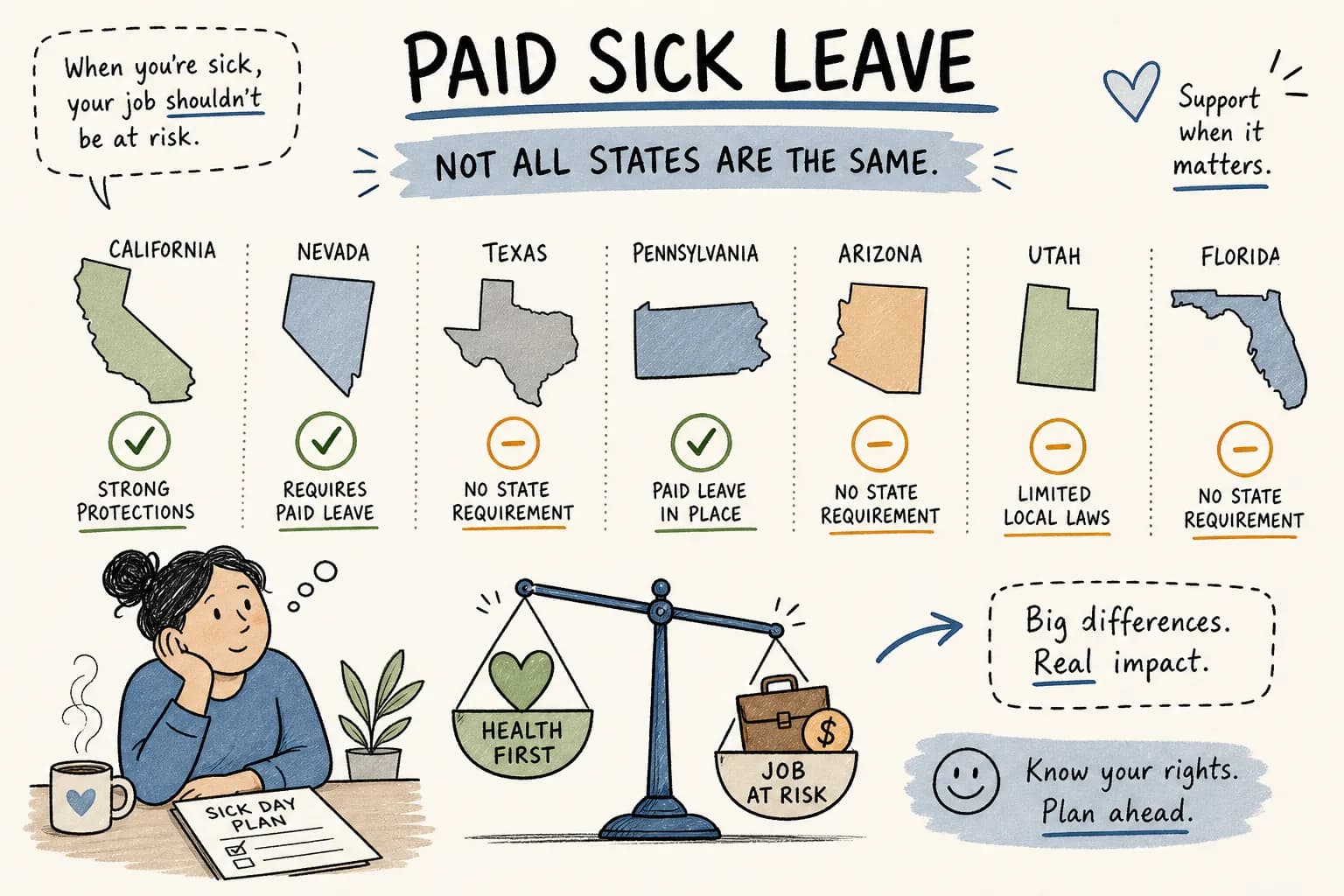
A multistate employer opens the handbook to rewrite one paragraph. The company has a distribution site outside Phoenix, a small sales office in Las Vegas, a remote engineer in Salt Lake City, two people in Philadelphia, one in a Pittsburgh coworking space, a Dallas account team, a Tampa contractor-turned-employee, and a California headquarters. The plan is a single sick-leave paragraph that satisfies everyone. There is no such paragraph. Across these seven states there are three state mandates, local ordinances stacked on top of the state floor in two of them, three states that mandate nothing, and two of those three affirmatively forbid their own cities from filling the gap.
Here is what actually applies, and where the drafting traps sit.
Three of the seven mandate paid sick leave at the state level
California, Nevada and Arizona each have a statewide accrual mandate. Texas, Pennsylvania, Utah and Florida have none — but Pennsylvania is not a blank, because three local jurisdictions inside it impose real, enforceable accrual duties. California carries a local layer too: eight of its cities run their own ordinances on top of the state law, covered below.
The federal floor supplies nothing paid. The FMLA gives unpaid, job-protected leave and only at employers with 50 or more employees, so it never answers the sick-day question for a small employer.
California — no size floor, and "40 hours" is a cap, not a grant
California's Healthy Workplaces, Healthy Families Act sits at Labor Code §§ 245–249. The threshold question most employers get wrong is that there isn't one: "employer" is defined at § 245.5(b)(1) with no size floor at all. One employee triggers it.
Accrual is not less than 1 hour per 30 hours worked, beginning at hire, for an employee who works 30 or more days in California for the same employer within a year. The employee may first use the time on the 90th day of employment.
The number everyone repeats — 40 hours or 5 days, raised from 24/3 by SB 616 effective January 1, 2024 — is a permitted cap on annual use under § 246(d), not an automatic annual grant. It becomes a guaranteed floor only two ways: the employer front-loads the full amount at the start of the year, or the employer satisfies § 246(b)(4) by making 24 hours or 3 days available to use by the 120th calendar day and 40 hours or 5 days by the 200th. Otherwise accrual carries over, subject to a separate total accrual cap of 80 hours or 10 days under § 246(j). Read the "hours or days" pairing carefully before converting it into a policy: § 246 states both units side by side without defining a shift length, so a handbook written only in days can under-deliver for an employee on long shifts. The California paid sick leave guide works through the mechanics.
Eight California cities add their own ordinance on top
The statewide figures are a floor, not the whole answer. San Francisco, Oakland, Berkeley, Emeryville, Los Angeles (city), Santa Monica, West Hollywood and San Diego (city) each run their own paid sick leave ordinance. Where an employee works in one of them, the Labor Commissioner's position is that both laws apply at once: "if employees are subject to local sick leave ordinances, the employer must comply with both the local and California laws, which may differ in some respects. The employer must provide the provision or benefit that is most generous to the employee" (DLSE paid sick leave FAQ).
One carve-out has applied since January 1, 2024. On six specific mechanics — lending of paid sick leave, paystub statements, how leave is calculated, notice for foreseeable leave, timing of payment, and whether accrued leave is paid out at termination — a conflicting local rule gives way and state law controls. Everywhere else, the more generous provision wins.
The differences are not cosmetic. State law lets you cap an employee's use at 40 hours or five days a year; Berkeley does not permit an employer with 25 or more employees to cap annual use at all, and San Francisco's caps limit the running balance rather than the year. Los Angeles sets annual use at 48 hours rather than 40. Emeryville widens who the leave may be spent on, reaching a designated individual where the employee has no spouse or registered domestic partner, and care for a guide, signal or service dog. San Diego now tracks the state numbers, so its practical bite is separate local enforcement rather than extra hours.
Two jurisdictions are commonly assumed to be on this list and are not. Unincorporated Los Angeles County has a minimum wage, a Fair Workweek ordinance and hotel worker protections, but no general paid sick leave ordinance. Long Beach requires compensated sick days for hotel workers only. Local ordinances move — confirm against the city's own labor standards office before a policy goes into the handbook.
Nevada — paid leave for any reason, at 50+ employees in Nevada
Nevada does not have a sick-leave law. It has a paid leave law, and the difference is the point. Under NRS 608.0197, a private employer with 50 or more employees in Nevada must let employees accrue paid leave usable for any reason, with no requirement that the employee state one. An employer in its first two years of operation is exempt.
Accrual is 0.01923 hours per hour worked — roughly one hour for every 52 hours, or about 40 hours a year for a full-time employee. Front-loading is allowed. The employer must allow the employee to use the time beginning on the 90th calendar day of employment — a duty on the employer, not a bar on the employee — and may require advance notice.
Two separation rules travel together and have to be read as a pair. Payout of unused leave at separation is optional — NRS 608.0197(1)(i) says the employer may, but is not required to, compensate the employee. But if the employee is rehired within 90 days and the separation was not a voluntary quit, the previously unused hours must be reinstated. A more generous contractual PTO benefit is not preempted (NRS 608.0197(6)(c)). See the Nevada paid leave guide for the notice and posting details.
Arizona — every employer, with the cap set by headcount
Arizona's earned paid sick time, from Prop 206, is at A.R.S. § 23-372 and § 23-373. It applies to employers of all sizes. Accrual is 1 hour per 30 hours worked. The annual cap is the only place size matters: 40 hours at 15 or more employees, 24 hours below 15.
Count the heads by the statute, not by intuition. Under § 23-372(C), full-time, part-time and temporary employees all count, and a fluctuating workforce hits 15 or more for the current year if the employer employed 15 or more in twenty or more different calendar weeks in the current or preceding year. A business that thinks of itself as a twelve-person shop can owe the 40-hour cap. Unused time need not be paid out at separation (§ 23-372(F)), but accrued time is reinstated on rehire within nine months. And documentation may be required only where the absence covers three or more consecutive work days (§ 23-373(G)).
Pennsylvania — no state law, three local regimes, and they do not stack
Pennsylvania has no statewide paid-sick-leave statute. What state law does is make an employer's own promise enforceable through the Wage Payment and Collection Law (43 P.S. §§ 260.1–260.12). Three localities impose an actual accrual duty.
| Jurisdiction | Covered employers | Accrual | Annual cap | Authority |
|---|---|---|---|---|
| Philadelphia | Paid at 10+ employees; unpaid below 10. Chain establishments (same trade name at 15+ establishments) are paid at any size | 1 hr per 40 hrs worked in the city | 40 hours | Phila. Code §§ 9-4103(5), 9-4104(1)(a), (b) |
| Pittsburgh | All sizes, paid | 1 hr per 30 hrs worked in the city | 72 hrs at 15+; 48 hrs below 15 | Pittsburgh Code § 626.03(b), (c), as amended by Ord. 2025-1736 |
| Allegheny County (outside Pittsburgh) | 26+ employees, paid | 1 hr per 35 hrs worked in the county | 40 hours | ACHD Rules & Regs. art. XXIV §§ 2403(B), 2411(B) (Ord. 15-21-OR) |
Three points worth stating plainly, because each one is easy to get backwards:
Philadelphia's ten-employee line is paid-versus-unpaid, not covered-versus-not. § 9-4104(1)(a) requires employers with ten or more employees to provide paid sick time; § 9-4104(1)(b) requires every smaller employer to provide unpaid sick time. The size definition at § 9-4103(5) uses a forty-weeks-in-a-calendar-year test, not a headcount taken on the day someone calls in. A four-person franchise operating under a trade name used at 15 or more establishments owes paid time anyway.
Pittsburgh's January 1, 2026 change was to the caps, not the rate. Ord. 2025-1736 (enacted June 10, 2025) set the caps at 72 hours for employers with 15 or more employees and 48 hours below that. The 1-hour-per-30 accrual rate predates the amendment and did not change. The city's authority to impose the mandate at all was settled earlier: the Supreme Court of Pennsylvania upheld the underlying Paid Sick Days Act in Pennsylvania Restaurant & Lodging Ass'n v. City of Pittsburgh, 211 A.3d 810 (Pa. 2019) — a decision about the original ordinance, not about the 2025 amendment, which postdates it.
Pittsburgh and Allegheny County do not overlap. ACHD art. XXIV § 2411(B) yields to any municipality with a not-less-stringent ordinance, which is exactly what removes Pittsburgh from the county rule. A Pittsburgh employer answers to Pittsburgh. A suburban Allegheny County employer answers to the County. Applying both is not conservative, it is wrong. The Pennsylvania local paid sick leave guide covers the locality question in more depth.
Texas, Utah and Florida — nothing, and no local workaround
These three are not merely silent. Each closes the local route, though by different mechanisms.
Texas. No state mandate, and the operative bar is the Texas Minimum Wage Act, Tex. Labor Code ch. 62. Austin's paid-sick-leave ordinance was held preempted by that Act, and therefore unconstitutional, in Texas Ass'n of Business v. City of Austin, 565 S.W.3d 425 (Tex. App.—Austin 2018, pet. denied); the Dallas and San Antonio ordinances were separately blocked on the same preemption ground and never took effect. For a Dallas employer the operative authority is the statute rather than the case list — there is no enforceable local mandate to comply with.
Utah. The bar is Utah Code § 10-8-84.5(2), which prohibits a municipality from requiring a private employer to provide an employee benefit and names sick leave expressly; § 17-60-507 is the county counterpart. Do not cite § 34-40-106 for this — that section preempts local minimum wages, not leave, and citing it invites a correct objection that your analysis is off-point.
Florida. Fla. Stat. § 218.077 bars a political subdivision from requiring an employer to provide employment benefits not otherwise required by state or federal law, which is what forecloses a local sick-leave ordinance.
Seven-state comparison
| State | State mandate? | Covered employers | Accrual rate | Annual cap | Authority |
|---|---|---|---|---|---|
| California | Yes | All sizes, no floor | 1 hr / 30 hrs worked | 40 hrs or 5 days use cap; 80 hrs / 10 days total accrual cap — 8 city ordinances may exceed this | Lab. Code §§ 245–249; local ordinances |
| Nevada | Yes — paid leave, any reason | 50+ employees in Nevada, after 2 years of operation | 0.01923 hr / hr worked (~40 hrs/yr) | ~40 hrs/yr; payout optional, reinstatement on rehire within 90 days | NRS 608.0197 |
| Arizona | Yes | All sizes | 1 hr / 30 hrs worked | 40 hrs at 15+; 24 hrs under 15 | A.R.S. §§ 23-372, 23-373 |
| Pennsylvania | No — but three local regimes | Philadelphia, Pittsburgh, Allegheny County (see table above) | 1 per 40 / 1 per 30 / 1 per 35 | 40 / 72–48 / 40 | Phila. Code ch. 9-4100; Pittsburgh Code ch. 626; ACHD art. XXIV |
| Texas | No | — | — | — | Local ordinances preempted, Tex. Labor Code ch. 62 |
| Utah | No | — | — | — | Local mandates barred, Utah Code § 10-8-84.5(2) |
| Florida | No | — | — | — | Local mandates barred, Fla. Stat. § 218.077 |
What to do
Stop drafting one policy and start drafting a floor plus four exceptions. Set a company-wide baseline that clears the most demanding rule you actually face, then write California, Nevada, Arizona and the relevant Pennsylvania locality as named carve-outs with their own accrual rates, caps, waiting periods and separation rules — because those are the four places where a generic "10 PTO days" grant can still fail an audit on mechanics it never addressed. For Pennsylvania, the first question is not the state, it is the address where the employee physically works. Then verify each figure against the statute before it goes into the handbook, and re-verify the Pittsburgh caps and the California accrual alternative in January, when this category tends to move. If you need to work a specific fact pattern — a remote employee split across two of these states, or a franchise brushing Philadelphia's chain rule — the assistant answers with the controlling citation attached.
This article is general information, not legal advice. Verify every figure against the primary source before making a compliance decision, and take fact-specific questions to an employment attorney licensed in your state.
Need this for a specific state?
This article covers the process. The assistant answers a specific question about a specific state with the governing statute attached, across California, Nevada, Texas, Pennsylvania, Arizona, Utah and Florida.
Ask the HR assistantGeneral information, not legal advice. Employment law varies by state and locality and changes over time — confirm against the governing statute before acting on it.