
Performance improvement plan versus progressive discipline: when to coach, document, or terminate
12 min read · Published August 12, 2026
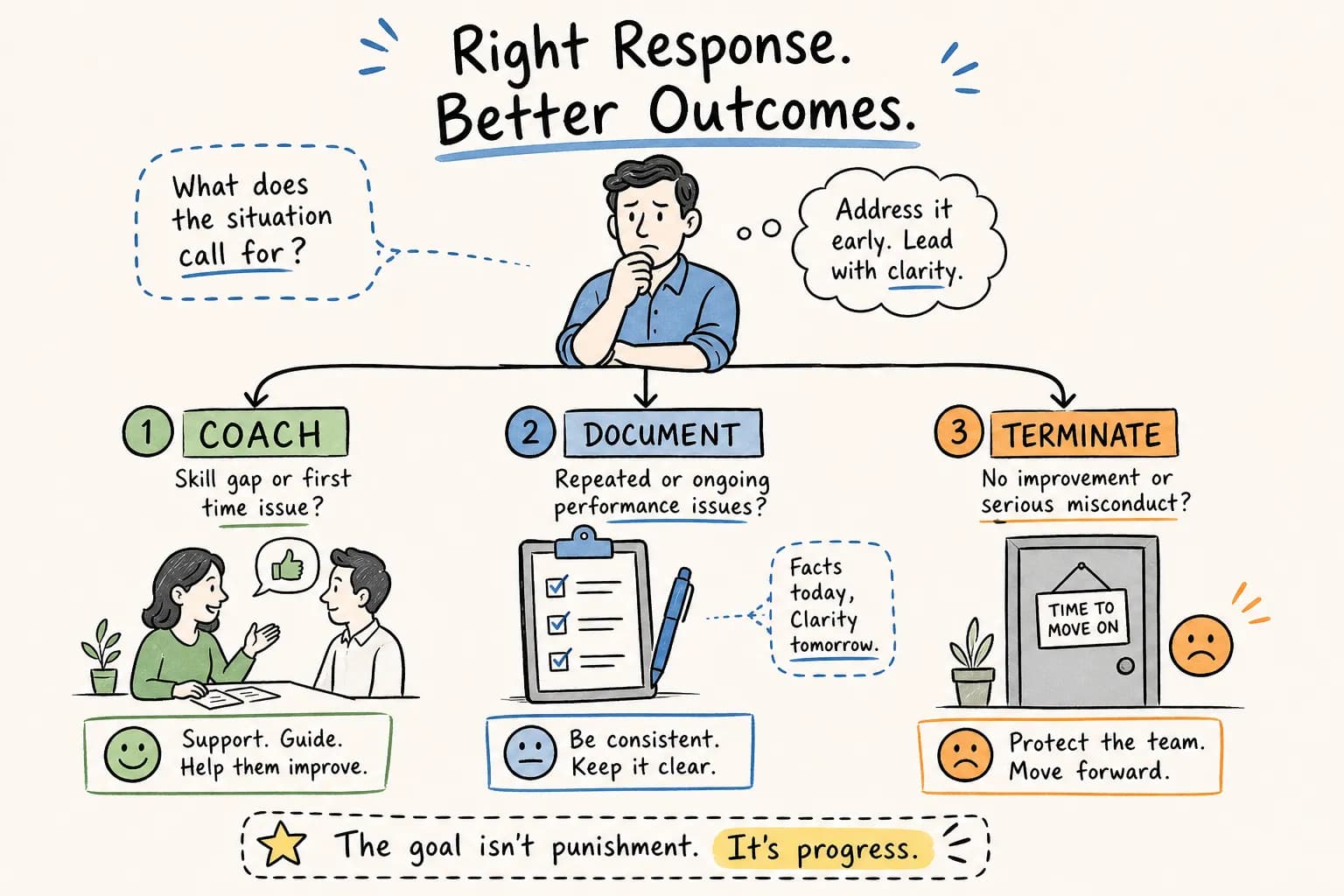
Most managers make one of two mistakes when performance problems surface. They either skip straight to a formal performance improvement plan when a direct coaching conversation would have fixed the issue in a week, or they keep having informal talks for months while the documentation file stays empty and the legal exposure grows. Both errors are expensive, and both are avoidable with a clear framework for deciding which tool to reach for and when.
This article walks through the full sequence: what a performance improvement plan actually is, how it differs from coaching, how to build one that holds up to scrutiny, and the state-specific pitfalls that turn a routine HR process into an employment lawsuit. It covers federal law and the seven states this site publishes guides for: California, Nevada, Texas, Pennsylvania, Arizona, Utah, and Florida.
What a performance improvement plan is and how it differs from coaching
A performance improvement plan is a formal, written document that identifies a specific performance gap, sets measurable improvement targets, defines a timeline, and states the consequences if those targets are not met. It is not a punishment, a warning letter, or a termination decision dressed up in paperwork. That legal distinction matters because courts and agencies look at whether the employer gave the employee a genuine, structured opportunity to succeed before ending the employment relationship.
Coaching is informal, ongoing, and conversational. It works well for new employees still developing skills, isolated one-off mistakes, or behavioral patterns that haven't yet crossed into a documented, recurring failure. A PIP, by contrast, creates a written record with specific goals, timelines, and stated consequences. Employers frequently confuse the two tools or skip coaching entirely and jump straight to the formal plan, which can read as retaliatory if the employee is a member of a protected class and there's no documented history of informal correction first. The EEOC's retaliation guidance treats lowered evaluations and written reprimands as materially adverse actions, so a plan is never too small to anchor a retaliation claim.
Within a progressive discipline structure, the formal improvement plan typically sits at the third rung: the issues have been raised before, coaching has not resolved them, and the employer needs a documented, time-bound plan before a termination decision is defensible. Some serious misconduct situations, harassment or theft, for example, bypass this step entirely and go straight to termination. Understanding where the tool belongs in that sequence is the foundation of using it correctly.
Decision framework: when to issue a performance improvement plan (PIP)
A formal employee improvement plan is the right tool when the performance issue is documented and recurring, prior coaching conversations have been held and noted, the role has clear measurable standards that aren't being met, and the employer genuinely wants to give the employee a structured path back to acceptable performance. If the file shows no prior coaching notes and no documented warnings, issuing a PIP suddenly creates legal exposure rather than reducing it.
Coaching remains the better choice when the problem is recent, isolated, or skill-based with no pattern of repetition. New hires within their first 90 days, employees navigating a role change, or workers dealing with a temporary personal disruption often respond well without the formal weight of a written performance action plan. Jumping to the formal process too early can demotivate an otherwise improvable employee and open the employer to claims that the process was punitive rather than corrective.
Termination without a PIP is appropriate for serious misconduct such as harassment, theft, or workplace violence. It's also the right call when the documentation already establishes a complete, consistent record of failure, when a prior plan was completed and the same issues have returned, or when continued underperformance in a business-critical role creates immediate operational or legal risk. Whatever the reason, the decision to skip the improvement plan must be supported by the file, not made on instinct.
How to build a legally sound performance improvement plan, step by step
No statute tells a private employer what a performance improvement plan must contain. The closest thing to an official model is the federal government's own performance improvement plan quick guide, a federal-agency process under 5 C.F.R. Part 432 that does not bind private employers but whose checklist travels.
Start with employee and role details: name, title, manager, department, and plan start and end dates. Add a factual description of the deficiency with dated examples, the standard being missed, and measurable SMART goals; the support the employer will provide; a review schedule; and a monitoring method tied to an objective system of record. Close with a consequence statement and a signature line for acknowledgment of receipt, that signature confirms the employee received the plan, not that they agree with it.
Vague goals are where improvement plans fall apart legally. Each goal must state what the employee must do, how it will be measured, and by when. A few practical examples:
- Attendance:"For the next 60 days, maintain no more than one unexcused absence and arrive on time for at least 95% of scheduled shifts, as tracked in the attendance log."
- Productivity:"Within 60 days, complete at least 10 assigned cases per day on 90% of workdays, measured in the case management system."
- Quality:"Over the next 90 days, reduce error rate to below 3% on completed tasks as measured by QA review."
- Communication:"For the next six weeks, respond to internal messages within one business day in at least 90% of cases."
Each goal should reference the specific system of record where progress will be documented.
Timeline structure and check-in cadence
The 30-60-90 day structure is the common practice standard for plan timelines. Use 30 days for narrow, tactical issues; 60 days for moderate skill or behavior gaps; and 90 days for complex, multi-dimensional performance problems. Weekly check-ins are the minimum for any plan, with a formal milestone review at day 30 and day 60 for 90-day plans. Each check-in must be documented with the date, progress notes on each goal, coaching provided, and next action items.
Checking the rule before the plan goes out
No template makes a plan lawful. What does is checking the employment rules for the state the employee actually works in. The performance improvement plan guide, the per-state guides under Resources, the HR compliance thresholds table, and the AI HR Assistant all cover that ground.
State-specific legal pitfalls that can turn a PIP into a lawsuit
California's Fair Employment and Housing Act splits its coverage, and the split is the first thing to get right. FEHA harassment liability reaches an employer of one or more employees, while FEHA discrimination and retaliation take Government Code § 12926(d)'s definition of an employer as a person "regularly employing five or more persons" (Gov. Code § 12926(d)). The retaliation provision, Gov. Code § 12940(h), bars acting against someone for opposing a FEHA-forbidden practice or filing a complaint. A plan issued while an employee is on CFRA or pregnancy disability leave, has requested an accommodation, or has recently complained about harassment can read as retaliation. California also adds a timing rule the other six states lack, and it is narrower than it is usually described: SB 497 (2023) amended the Labor Code so that adverse action within 90 days of a wage, whistleblower, safety or equal-pay complaint creates a rebuttable presumption of retaliation (Lab. Code § 98.6, § 1102.5, § 1197.5). It attaches to those Labor Code complaints, not to FEHA activity, and no other state here has an equivalent — do not carry it across a state line. Run a comparability check before delivering any PIP in California; inconsistent treatment of similarly situated employees becomes exhibit A. Under federal law, a covered employer may not treat FMLA leave as a negative factor in discipline or count it under a no-fault attendance policy (29 C.F.R. § 825.220(c)).
Nevada operates a two-track overtime rule of its own, and it directly affects how productivity targets are written. Employees earning less than 1.5 times the state minimum wage — under $18.00 per hour while the minimum is a flat $12.00 — get overtime after eight hours worked in any 24-hour period as well as after 40 in a week; those at or above that rate get overtime only after 40 hours (NRS 608.018). Its exemption list at NRS 608.018(3) does not track the FLSA's. Nevada also requires a paid 10-minute rest period for each four hours worked or major fraction, and a 30-minute meal period for a continuous eight-hour shift, at locations with two or more employees (NRS 608.019); the statute is silent on whether that meal period must be unpaid or duty-free, so do not import California's rule. A target the employee can only hit by working through breaks or past eight hours creates a wage-and-hour claim on top of the performance dispute. See the Nevada overtime and break guides.
The remaining states carry a different trap, and it lives in the plan document itself. Arizona's Employment Protection Act allows a wrongful-termination claim for breach of a written contract, and that contract can sit in "the employment handbook or manual or any similar document distributed to the employee, if that document expresses the intent that it is a contract of employment" (A.R.S. § 23-1501(A)(2)) — so keep the plan conditional, leave any at-will statement intact, and never write it as a promise of continued employment. Pennsylvania's Human Relations Act reaches employers with four or more employees (43 P.S. § 954(b)), a lower floor than Title VII's fifteen. Florida's private Whistleblower Act protects an employee who objected to or refused to participate in an employer practice that is an actual violation of a law, rule or regulation (Fla. Stat. § 448.102) — not merely one the employee reasonably believed unlawful — but it reaches only employers of ten or more persons (§ 448.101(3)), and related entities can be aggregated to cross that line. Texas is not the blank slate it is often called: the Texas Commission on Human Rights Act (Labor Code ch. 21) mirrors Title VII at fifteen or more employees for a private employer — a county, municipality, state agency, or state instrumentality is covered at any size (§ 21.002(8)(D)) — and its sexual-harassment provisions reach an employer that "employs one or more employees" (SB 45 (2021), Tex. Labor Code § 21.141), so a Texas plan issued after a harassment complaint carries state exposure no headcount removes. In Utah, a plan ending in involuntary discharge triggers final wages within 24 hours (Utah Code § 34-28-5).
The safest documentation language in any state is objective, behavior-based, and tied to a system of record. Replace "bad attitude" with "failed to respond to three client emails within the required one-business-day window on 4/3, 4/10, and 4/17." Replace "not a team player" with "declined to complete two cross-departmental project tasks assigned on 4/5 and 4/12, as documented in the project management system." Avoid subjective character descriptions entirely, and where English is not the employee's strongest language, have a professional translation prepared — it forecloses the "I never understood the plan" argument. Never backdate documentation or reconstruct notes after the fact, after-the-fact records are discoverable, and they undermine an employer's credibility in any forum.
Running the PIP: check-ins, evidence tracking, and the escalation decision
The improvement plan itself is only as strong as the documentation that supports it during the review period. Maintain a running log of each check-in with time-stamped notes, preserve system-generated reports such as QA scores, attendance records, and case management output, and save copies of relevant communications. Write check-in notes within 24 hours of each meeting. The goal is a chronological file that any third party, a judge, an investigator, or an HR auditor, can follow from day one to the final decision without gaps.
Published turnaround rates vary too widely to serve as benchmarks; track your own. Extend the plan only when the employee shows documented, upward progress that hasn't fully stabilized and the remaining gap is narrow enough that more time is likely to produce sustained improvement. Move to termination when the employee has not made measurable progress by the midpoint, when behavioral issues persist despite clear feedback, or when the business cannot tolerate continued underperformance in the role. The termination decision must be supported by the documented evidence file, not made in the moment.
The conversation that opens a performance improvement plan sets the tone for whether the employee engages or shuts down. Managers should state the problem factually, explain the goals and support clearly, invite questions, and avoid the word "termination" unless it is already the next step. At the final outcome meeting, use the same factual tone: walk through each goal, reference the documented progress notes, and state the decision in plain terms.
The bottom line on performance management plans
A performance improvement plan is one of the most powerful tools in an employer's HR toolkit when it's built correctly and used at the right moment. The decision to coach, document, or terminate is not a gut call. It's a process decision supported by a clear evidence file, consistent treatment across similar cases, and documentation language that holds up under scrutiny. In California and Nevada especially, the cost of getting that sequence wrong far exceeds the cost of getting it right the first time.
Getting the process right protects your organization, gives employees a fair opportunity to succeed, and keeps your documentation defensible if a dispute reaches a courtroom or agency. The AI HR Assistant is available for cited answers when a question comes up mid-plan. An employer who wants a professional to look at a high-risk plan before it is issued can contact Maggie Vinas, the independent HR consultant whose practice is separate from HR World Today.
Need this for a specific state?
This article covers the framework. The assistant answers a specific question about a specific state with the controlling statute attached, across California, Nevada, Texas, Pennsylvania, Arizona, Utah and Florida.
Ask the HR assistantGeneral information, not legal advice. Employment law varies by state and locality and changes over time — confirm against the governing statute before acting on it.