
Is unused PTO owed at separation? How payout rules work, and what they are in seven states
10 min read · Published September 3, 2026
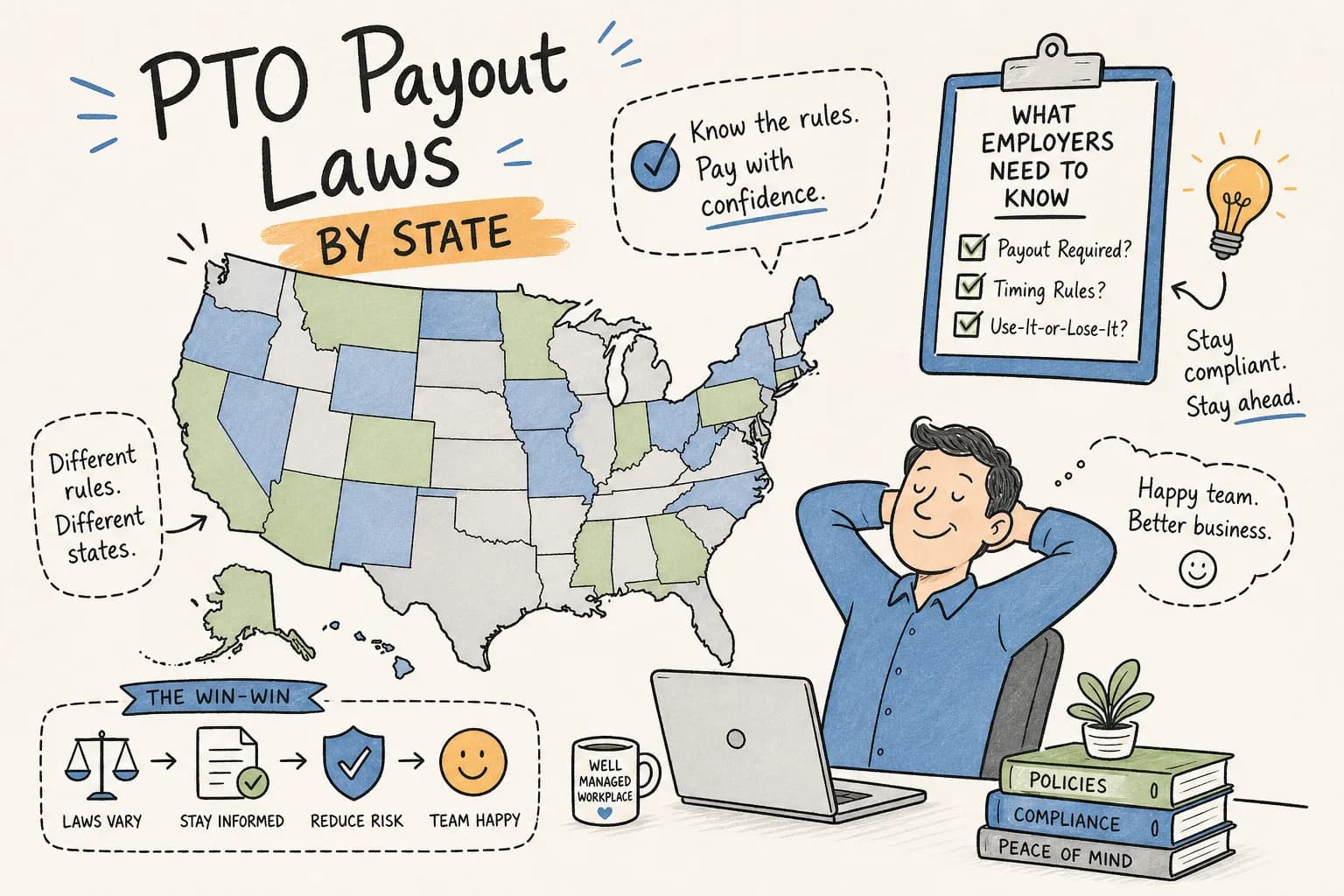
A termination is set for Friday. Payroll runs the numbers and notices the employee is sitting on seventy-eight hours in the PTO bank. The handbook says time off "does not carry over," says nothing about what happens when someone leaves, and was last revised when the company operated in one state. The manager wants to know whether that balance goes on the final check.
Whoever answers is making a wage decision under a statutory deadline, usually with a few hours to spare. It is not a matter of company preference, and it is not the same in every state.
The threshold question: earned wage, or benefit that expires?
Is the accrued balance money the employee has already earned, or a benefit the employer can define, limit and end?
Federal law does not answer it. The Fair Labor Standards Act governs minimum wage and overtime; it does not require paid vacation or holidays, and says nothing about unused time — the U.S. Department of Labor states plainly that these are matters of agreement between employer and employee. There is no federal payout rule to fall back on.
So it is a state question, and the seven states this site covers sort into two patterns, with a third distinction over both.
The three patterns
Pattern one: earned-wage states
Vacation vests as it is earned. Each day worked buys a fraction of the eventual paid day off, and that fraction belongs to the employee immediately. Accrued vacation is wages, and it goes out with the final paycheck. California is the only one of the seven.
Pattern two: policy-governed states
No statute creates a right to vacation or to its payout. The employer's written policy or agreement is the entitlement — the whole of it. A policy forfeiting accrued time at separation is generally enforceable; so is one promising payout.
That second half is where the exposure lives. Once the policy promises a payout, the promise stops being a discretionary benefit and becomes wages — inheriting the state's wage-payment statute: its final-pay deadline, penalties, fee-shifting and claim process. Texas, Arizona, Utah, Pennsylvania and Florida work this way, and so does Nevada for any vacation the employer offers on top of the statutory paid leave described below. One handbook sentence can convert a perk into a statutory obligation with a clock on it.
The distinction underneath both: a cap is not a forfeiture
An accrual cap is prospective: once the balance hits the ceiling, no further time accrues until the employee uses some down. Nothing already earned is lost. A forfeiture — "use it or lose it" — is retroactive: it takes back time already earned, usually at a year-end date.
In an earned-wage state a cap is lawful and forfeiture is not, because forfeiture confiscates vested wages. In a policy-governed state forfeiture can be lawful, but only where the written policy states the condition clearly and before the time is earned; an ambiguous policy is read against the employer that drafted it. If your handbook says "unused time does not carry over" and is silent on separation, you do not have a forfeiture clause. You have an ambiguity.
The seven states
| State | Payout at separation | Authority |
|---|---|---|
| California | Required where a policy or contract provides paid vacation; no forfeiture | Lab. Code § 227.3; Suastez |
| Nevada | Optional for statutory paid leave; reinstated on a qualifying rehire; vacation is policy-governed | NRS 608.0197(1)(i) |
| Texas | Only if a written agreement or written policy says so | Tex. Lab. Code § 61.001(7)(B) |
| Arizona | Only as promised; a promise is recoverable as wages | A.R.S. §§ 23-350(7), 23-353 |
| Utah | Only if due under an agreement or a policy | Utah Admin. Code R610-3-4(B)(1) |
| Pennsylvania | Only as promised in writing; then a wage supplement | 43 P.S. §§ 260.2a, 260.5 |
| Florida | Not required; no general final-pay statute either | Fla. Stat. ch. 448 |
California
California does not require an employer to offer paid vacation. But once it does, vacation vests as it is earned and is treated as a form of wages — the holding of Suastez v. Plastic Dress-Up Co., 31 Cal.3d 774 (1982). Use-it-or-lose-it is therefore unlawful; a reasonable accrual cap is the lawful substitute.
At separation, Labor Code § 227.3 requires vested vacation to be paid at the employee's final rate — but the statute carries two conditions that are routinely dropped. It applies only "whenever a contract of employment or employer policy provides for paid vacations," and only "[u]nless otherwise provided by a collective-bargaining agreement." An employer that offers no paid vacation owes no § 227.3 payout, and a CBA can displace the rule.
The payout is due with the rest of the final wages — on an involuntary termination, at the moment of discharge under Labor Code § 201. The California vacation and PTO guide walks through the mechanics.
Unlimited-vacation plans complicate this rather than solving it: if nothing accrues, there may be no defined balance to pay. But the label alone does not decide it — a plan that operates like an accrual plan is a fact-specific question for counsel.
Nevada
Do not conflate two different things. Nevada's statutory paid leave under NRS 608.0197 applies to private employers with 50 or more employees in Nevada (those in their first two years of operation are exempt), and is separate from any vacation benefit the employer offers.
For that statutory leave, payout is optional. The statute says an employer "may, but is not required to, compensate an employee for any unused paid leave" available for use on separation — NRS 608.0197(1)(i). The condition attached to that sentence is easy to miss: if the employee is rehired within 90 days and the separation was not a voluntary quit, previously unused hours must be reinstated.
Vacation offered on top of that statutory floor is governed by the employer's own policy. Whatever is owed goes out on Nevada's ordinary final-pay clock — immediately on discharge under NRS 608.020, and by the earlier of the next regular payday or seven days on a resignation under NRS 608.030.
Utah
Utah creates no independent entitlement. Utah Admin. Code R610-3-4(B)(1) extends "wages" for wage-claim purposes to vacation, holiday, sick leave, PTO, severance and bonuses — but only "if due under an agreement with the employer or under a policy of the employer." A clearly stated forfeiture policy is enforceable.
Here is the trap. Where the policy does promise payout, the balance becomes wages — and Utah runs a hard 24-hour final-pay deadline on involuntary separation under Utah Code § 34-28-5(1)(a). A payout sentence in a handbook becomes a same-day obligation the moment somebody is discharged.
Pennsylvania
No Pennsylvania statute creates a right to vacation. But the Wage Payment and Collection Law defines "fringe benefits or wage supplements" to expressly include "separation, vacation, holiday, or guaranteed pay" (43 P.S. § 260.2a), so once a written policy or contract promises vacation pay, that promise is recoverable as wages — with liquidated damages of 25% or $500, whichever is greater, plus attorney fees on the table (43 P.S. § 260.10). Payment is due by the next regular payday under 43 P.S. § 260.5, not immediately. Forfeiture is permitted only where the written policy clearly states the condition before the time is earned; ambiguity is construed against the drafter.
Texas, Arizona and Florida
None of the three requires a payout by statute, and in each the written policy or agreement governs.
Texas puts it in the definition: "wages" includes "vacation pay ... owed to an employee under a written agreement with the employer or under a written policy of the employer" — Tex. Lab. Code § 61.001(7)(B). No written agreement or written policy, no payout. Where one exists, final pay is due within six calendar days of a discharge and by the next regularly scheduled payday on a quit (§ 61.014), enforced by the Texas Workforce Commission.
Arizona defines "wages" as nondiscretionary compensation the employee has "a reasonable expectation to be paid" (A.R.S. § 23-350(7)), broad enough to carry a promised payout. Final pay on discharge is due within seven working days or the end of the next regular pay period, whichever is sooner (A.R.S. § 23-353).
Florida is the sparest of the seven: no accrued-leave payout provision, and no general private-sector final-pay-timing statute at all (Fla. Stat. ch. 448). Payout, forfeiture and carryover are governed entirely by the contract, the written policy, or a consistent past practice, enforced as an ordinary contract claim rather than a wage claim. Do not quote a Florida final-pay deadline; there isn't one.
Running the payout through payroll
Once the balance is owed, the mechanics are federal and identical in all seven states: a PTO payout is supplemental wages for federal income-tax withholding. Per IRS Publication 15, section 7:
- Paid as a separate payment from regular wages: you may use the flat supplemental rate of 22%, up to $1 million of supplemental wages paid to that employee in the calendar year.
- Above $1 million in supplemental wages for the year: the excess is withheld at 37%, without regard to the employee's Form W-4.
- Combined with regular wages in a single payment: use the aggregate method — treat the total as one payment and withhold using the employee's Form W-4 and the withholding tables.
Social Security and Medicare tax apply either way; the choice of method changes income-tax withholding, not FICA. And there is no special box on the Form W-2 — the payout lands in Box 1 with the rest of the year's wages, and in Boxes 3 and 5 to the extent it is subject to Social Security and Medicare.
Two details that cause disputes: pay a California payout at the employee's final rate, not the rate when the time accrued; and never net a payout against unreturned equipment without first checking the state's deduction rules.
What to fix in the policy now
- Find the separation sentence. Locate the sentence saying what happens to an accrued balance when employment ends. If there isn't one, that is the finding — write it before the next termination, not during it.
- Stop treating "does not carry over" as a payout answer. Carryover and separation are different events. Address both.
- Replace forfeiture with a cap wherever California employees are covered, set at a number the business can absorb.
- Check whether the policy accidentally promises payout. In a policy-governed state that sentence is the entitlement, and it drags the final-pay deadline and penalties with it.
- Separate sick leave from the vacation bank where a combined bank would sweep statutory sick or paid leave into a payable balance.
- In Nevada, put the rehire-reinstatement rule in the offboarding checklist — the 90-day condition is triggered by a rehire decision made long after HR closed the file.
- Audit by work location, not headquarters. A policy written for a Texas head office does not survive contact with a California remote hire.
Start with the sentence in the handbook, because outside California it does almost all the work: in the other six states that sentence, not a statute, decides whether an accrued vacation balance is owed — subject in Nevada to the statutory leave rules above it. Then confirm the final-pay deadline where the employee actually works: a correct payout delivered late is still a wage violation, and in California and Utah "late" arrives within hours. To pressure-test a policy against a particular state's rule, the assistant answers with the citation attached.
This article is general information, not legal advice. Verify every figure against the primary source before making a compliance decision, and take fact-specific questions to an employment attorney licensed in your state.
Need this for a specific state?
This article covers the process. The assistant answers a specific question about a specific state with the governing statute attached, across California, Nevada, Texas, Pennsylvania, Arizona, Utah and Florida.
Ask the HR assistantGeneral information, not legal advice. Employment law varies by state and locality and changes over time — confirm against the governing statute before acting on it.