
Seven steps to take when an employee reports a hostile work environment
10 min read · Published September 3, 2026
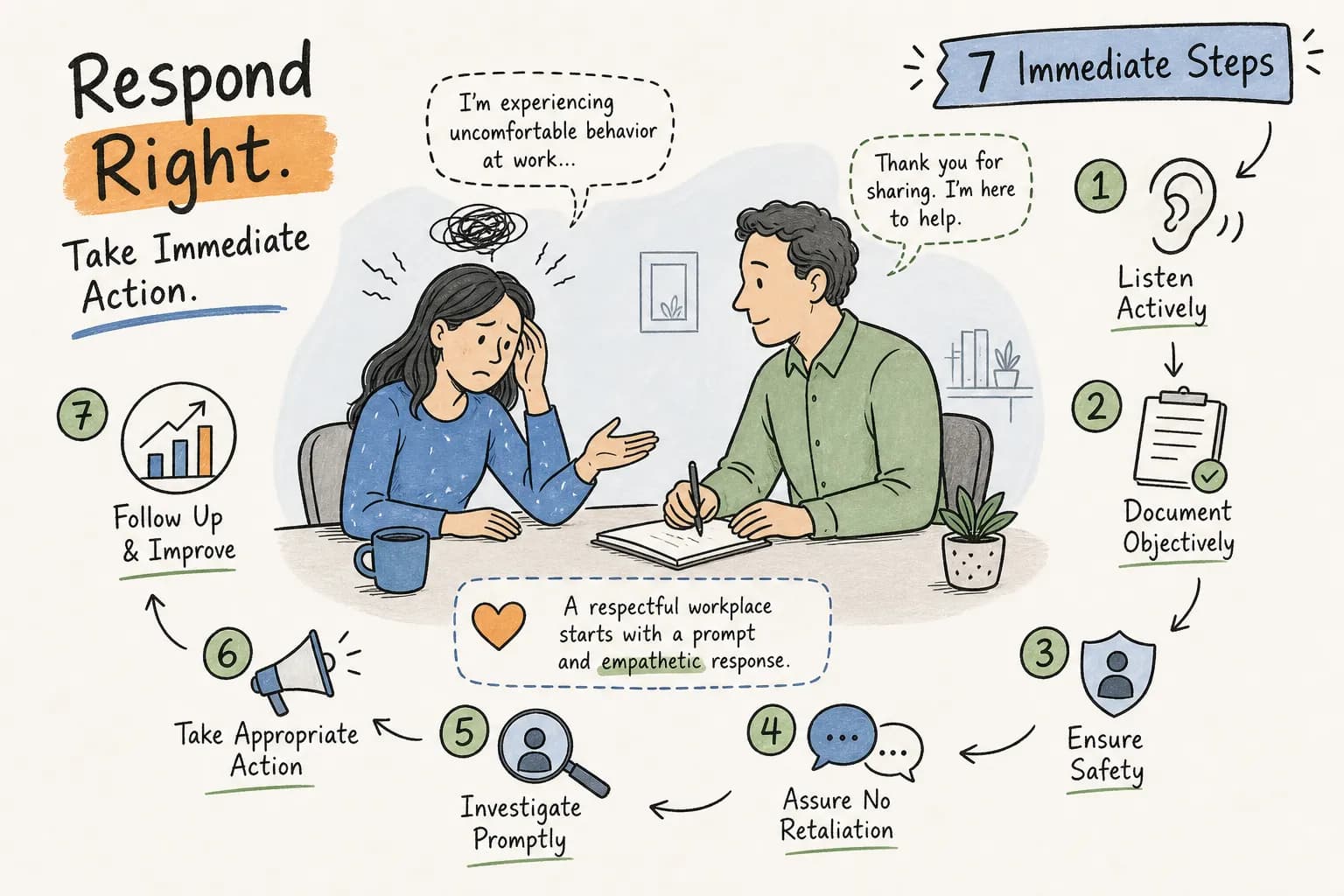
An employee stops you in the hallway at 4:40 on a Friday. She says she cannot keep working under her supervisor, that the comments have gone on for months, that this is "a hostile work environment" — then asks you not to do anything, because she does not want to be the person who caused trouble. She will not put it in writing.
Your legal clock started in that hallway. An employee never has to use the phrase, fill in a form, or be right about the law for the employer's duty to attach. What follows is the sequence that keeps the response from becoming a bigger problem than the conduct.
What the standard actually is
Under Title VII, the ADA and the ADEA, harassment becomes unlawful when the conduct is unwelcome, is based on a protected characteristic, and is severe or pervasive enough that a reasonable person would find the environment intimidating, hostile or abusive — judged on the totality of the circumstances. The EEOC states the test in those terms on its harassment page, and it comes from the case law: Meritor Savings Bank v. Vinson, 477 U.S. 57 (1986) established that unwelcomeness, not voluntariness, is the question, and Harris v. Forklift Systems, 510 U.S. 17 (1993) set the reasonable-person and totality framing. The EEOC's sexual-harassment regulation at 29 C.F.R. § 1604.11 remains codified.
Read the connector carefully. It is or, never and. A single extremely serious incident can clear the bar, and so can an accumulation of individually minor conduct. An investigator who tells a complainant "it wasn't frequent enough" is applying a standard that does not exist.
The EEOC rescinded its 2024 enforcement guidance on workplace harassment on January 22, 2026. Withdrawing guidance repeals no statute and overrules no court — Title VII is unchanged, which is why the citations above are to the statute, the regulation and the cases.
What does not qualify
A manager who is harsh with everyone. A team under deadline pressure. Criticism the employee thinks is unfair. Favoritism. A badly run performance improvement plan. None of these is unlawful harassment unless it is tied to a protected characteristic — and the EEOC's own page says petty slights, annoyances and isolated incidents that are not extremely serious fall outside the law.
Say that internally, but do not treat it as a reason to skip the process. You cannot know whether conduct is tied to a protected characteristic until you ask; retaliation exposure attaches to the complaint regardless of the claim's merit; and lawful conduct can still violate your own policy.
Steps 1 and 2: the first 24 to 48 hours
1. Document the intake immediately
Same day, before memory softens. Capture the date and time of the report, who reported and who is named, what was described in the employee's own words (quote it — do not paraphrase into HR language), the dates, locations and witnesses named, documents referenced, what you said about confidentiality and non-retaliation, and what you committed to do next.
Do not promise confidentiality you cannot deliver — say you will share information only with people who need it to respond. If the employee asks you to do nothing, record that they asked and that you explained you must act anyway.
2. Put interim protections in place before you investigate
This step is where the employer's defense is built. Faragher v. City of Boca Raton, 524 U.S. 775 (1998) gives an employer facing supervisor-harassment liability an affirmative defense — but only where no tangible employment action was taken, and only on both prongs: that the employer exercised reasonable care to prevent and promptly correct harassing behavior, and that the employee unreasonably failed to use the employer's complaint procedures. "Promptly" is measured from the report, not from the end of your investigation.
Workable interim measures: changing reporting lines or schedules, suspending contact between the parties, paid administrative leave for the accused in serious cases, and pausing any performance action already in motion against the complainant. Do not move, reassign or reschedule the complainant as the fix unless they request it in writing. That single decision is the most reliable way to convert a harassment complaint into a retaliation claim.
Steps 3 to 5: an investigation that holds up
3. Assign an impartial investigator
Not someone in the reporting line of either party, not a witness, and ideally not the person who decides the discipline. Go external when a senior leader is named, when HR itself is implicated, or when litigation looks likely. Impartiality is a fact you may have to prove later — record why this investigator was chosen.
4. Interview in sequence, and gather the paper
Complainant first — full allegations, dates, locations, witnesses, documents. Then the accused, with fair notice of what is alleged and a genuine opportunity to respond; do not open with a conclusion. Then witnesses, each separately. Open-ended questions, contemporaneous notes, no leading.
Only after the interviews do you know which documents matter: the policy in force at the time, its acknowledgment signature, schedules, messages, calendars, and — the item easiest to overlook — prior complaints about the same individual, which bear on whether the employer knew or should have known.
5. Build a complete investigation file
The burden of proof is preponderance of the evidence, not beyond a reasonable doubt. The file holds the allegations as stated, who was interviewed and when, the evidence reviewed, credibility assessments with the reasons for them, a finding on each separate allegation, and the action taken. Keep it segregated from the personnel file, with restricted access.
6. Take corrective action proportional to the findings
The legal test is whether the action is reasonably calculated to end the conduct and prevent its recurrence — not whether somebody was fired. Coaching, a written warning, removal of supervisory authority, reassignment, training, or termination, matched to severity and history.
"Unsubstantiated" is not "false." Close the loop with both parties, restate the policy, and impose no consequence for having reported. Tell the complainant what was done at a level of generality you can defend — "we took corrective action" is usually both enough and necessary.
7. Monitor after the file closes
Check in with the complainant at roughly 30, 60 and 90 days, and document each check-in. Watch assignments, scheduling, ratings and any adverse action touching the complainant or the witnesses. Post-resolution monitoring is where the retaliation claim is either prevented or created.
Where state law raises the bar
California
California did not abolish the federal threshold. Gov. Code § 12923(b) provides that a single incident of harassing conduct "is sufficient to create a triable issue regarding the existence of a hostile work environment if the harassing conduct has unreasonably interfered with the plaintiff's work performance or created an intimidating, hostile, or offensive working environment."
That is a summary-judgment rule, not a liability rule. It governs whether the case reaches a jury; the jury still applies severe-or-pervasive, which the same subdivision treats as the operative FEHA test when it declares that Brooks v. City of San Mateo (9th Cir. 2000) 229 F.3d 917 "shall not be used in determining what kind of conduct is sufficiently severe or pervasive to constitute a violation of the California Fair Employment and Housing Act." Subdivision (e) adds that harassment cases "are rarely appropriate for disposition on summary judgment." The practical effect: thin facts are less likely to be disposed of on paper, and your investigation file is what a jury will read. In Bailey v. San Francisco District Attorney's Office (2024), the California Supreme Court held that a coworker's single use of a racial slur could be severe enough to be actionable.
Two coverage points matter. FEHA harassment liability reaches an employer "regularly employing one or more persons" (Gov. Code § 12940(j)(4)(A)), while the separate duty to take reasonable steps to prevent harassment under § 12940(k) tracks FEHA's five-employee definition. And the administrative filing window is three years (Gov. Code § 12960), so the file must survive far longer than most retention schedules assume. Our California harassment-training guide covers the separate 5+ training duty.
Texas
Texas is broader than its reputation. Since 2021, sexual-harassment liability under Tex. Labor Code §§ 21.141–.142 reaches employers with one or more employees, can attach to individuals personally, and requires the employer to take "immediate and appropriate corrective action" — a statute that makes your response time itself the legal standard. General discrimination coverage stays at fifteen employees, and charges go to the Texas Workforce Commission Civil Rights Division.
Filing windows differ sharply
Nevada, Pennsylvania, Arizona, Utah and Florida all apply the federal severe-or-pervasive standard. What differs is how long you stay exposed.
| Jurisdiction | Agency | Deadline | Source |
|---|---|---|---|
| Federal | EEOC | 180 days, extended to 300 where a state or local agency enforces a parallel law — as all seven here do | EEOC time limits (42 U.S.C. § 2000e-5) |
| California | CRD | 3 years to file the administrative complaint | Gov. Code § 12960 |
| Florida | FCHR | 365 days; cross-filing fixes the date at the earliest filing and cannot buy time | Fla. Stat. § 760.11(1) |
| Texas | TWC CRD | 180 days generally; 300 days for sexual harassment | Tex. Lab. Code § 21.202(a), (a-1) |
| Nevada | NERC | 300 days after the alleged practice occurred | NRS 233.160(1)(b) |
| Pennsylvania | PHRC | 180 days | 43 P.S. § 959(h) — PHRC filing page |
| Arizona | ACRD | 180 days after the practice occurred | A.R.S. § 41-1481(A) |
| Utah | UALD | 180 days after the practice occurs | Utah Code § 34A-5-107 |
In Arizona, Utah and Florida, dual filing with the EEOC does not extend the state deadline — the 300-day deferral window buys time on the federal charge only. Nevada is the exception: NRS 233.160(1)(b) provides that a complaint "is timely if it is filed with an appropriate federal agency within that period." Nevada also runs a second, separate clock for the lawsuit — under NRS 613.430 a civil action must be brought within 180 days of the act or 90 days after the right-to-sue notice, whichever is later, and that limitation is tolled while a NERC or EEOC complaint is pending. Do not read those 180 days as the charge deadline. The coverage thresholds that decide which of these rules reaches you are collected in the HR compliance threshold table.
Retaliation is separate exposure
A complainant who loses the harassment claim can still win a retaliation claim. Burlington Northern & Santa Fe Railway v. White, 548 U.S. 53 (2006) sets a deliberately broad test: any employer action that would dissuade a reasonable worker from making or supporting a charge of discrimination. The EEOC's retaliation materials reach conduct well short of termination.
California adds timing pressure. Labor Code § 98.6, as amended by SB 497 (2023), creates a rebuttable presumption of retaliation when adverse action follows protected activity within 90 days, with civil penalties up to $10,000 per employee; § 1102.5 protects an employee who reports suspected unlawful conduct internally to someone with authority to investigate or correct it. Any discipline of a recent complainant deserves a second reviewer and a documented, pre-existing reason.
What to do
Decide now what steps 1 and 2 look like in your organization, before the next complaint arrives: who takes the intake, who can authorize an interim measure without waiting for approval, and who investigates when the person named is a senior leader. That decision, made in advance, is worth more than any template. Our guide to handling a harassment complaint walks the same sequence in procedural detail, and the assistant answers state-specific questions with citations. A threatened claim or a likely termination goes to counsel before you act, not after.
This article is general information, not legal advice. Verify every figure against the primary source before making a compliance decision, and take fact-specific questions to an employment attorney licensed in your state.
Need this for a specific state?
This article covers the process. The assistant answers a specific question about a specific state with the governing statute attached, across California, Nevada, Texas, Pennsylvania, Arizona, Utah and Florida.
Ask the HR assistantGeneral information, not legal advice. Employment law varies by state and locality and changes over time — confirm against the governing statute before acting on it.