
How to Create SMART Goals for Employee Performance Plans That Reduce Legal Risk
13 min read · Published August 12, 2026
A California employer terminates an employee for "poor performance." The manager had counseled the employee multiple times, everyone on the team knew the work wasn't cutting it, and the decision felt airtight. Then a Civil Rights Department complaint lands on the employer's desk. The investigation question is simple: what documented, measurable expectation did the employee fail to meet? If the answer is "we told her to improve her attitude," the employer is in serious trouble. That's exactly the problem that SMART goals are designed to prevent, turning vague impressions into specific, defensible performance standards before a dispute ever starts.
It is one of the most common gaps in performance documentation, and it looks the same in California as it does in Nevada. Managers write performance expectations the way they think about them, which is often vague, impressionistic, and completely unenforceable. The fix is a structured goal-writing method that makes expectations specific enough to direct behavior and defensible enough to survive a dispute. By the end of this article, you'll know exactly how to apply that method, with examples and a SMART goal template you can put to work immediately.
Why Vague Performance Goals Create Legal Exposure
The Gap Between "Expectations" and Evidence
California and Nevada are both at-will states — California by statute at Lab. Code § 2922, Nevada by a judicial presumption the employee bears the burden of rebutting (Vancheri v. GNLV Corp., 105 Nev. 417 (1989)) — which leads many employers to assume that termination documentation is optional. It isn't. At-will status means you don't need cause to terminate, but it doesn't protect you from a wrongful termination or discrimination claim under the Fair Employment and Housing Act (Gov. Code § 12940). When the California Civil Rights Department reviews a complaint, investigators look for evidence that the employee received clear notice of expectations and a genuine opportunity to meet them. "Be more productive" doesn't provide that evidence. It reads as subjective, which makes it easy for an employee's attorney to argue the standard shifted based on who the employee was rather than what they did.
In Nevada, the analysis is similar under the Nevada Fair Employment Practices Act, NRS 613.330 and following, enforced by the Nevada Equal Rights Commission. It reaches employers with 15 or more employees — a threshold supplied by the chapter's definition at NRS 613.310(2), not by § 613.330 itself. The employer needs to show a legitimate, documented, performance-based reason for the adverse action. Vague language, such as "poor attitude" or "not a team player", gives the employee's counsel room to argue that the real reason was something protected. Measurable criteria close that gap before it becomes a legal problem.
What "Legally Defensible" Actually Means in HR Documentation
Defensibility doesn't mean you need a lawyer to draft every performance goal. It means any neutral third party, whether an arbitrator, a mediator, or an agency investigator, can read the goal and evaluate it objectively. The goal names a specific outcome, includes a measurable standard, sets a realistic timeframe, and connects to a legitimate business need. When your documentation meets that standard, disputes are far less likely to escalate because there's nothing ambiguous to argue about.
What the SMART Framework Means for HR (Not Just Business Goals)
Breaking Down Each Letter in a Performance Context
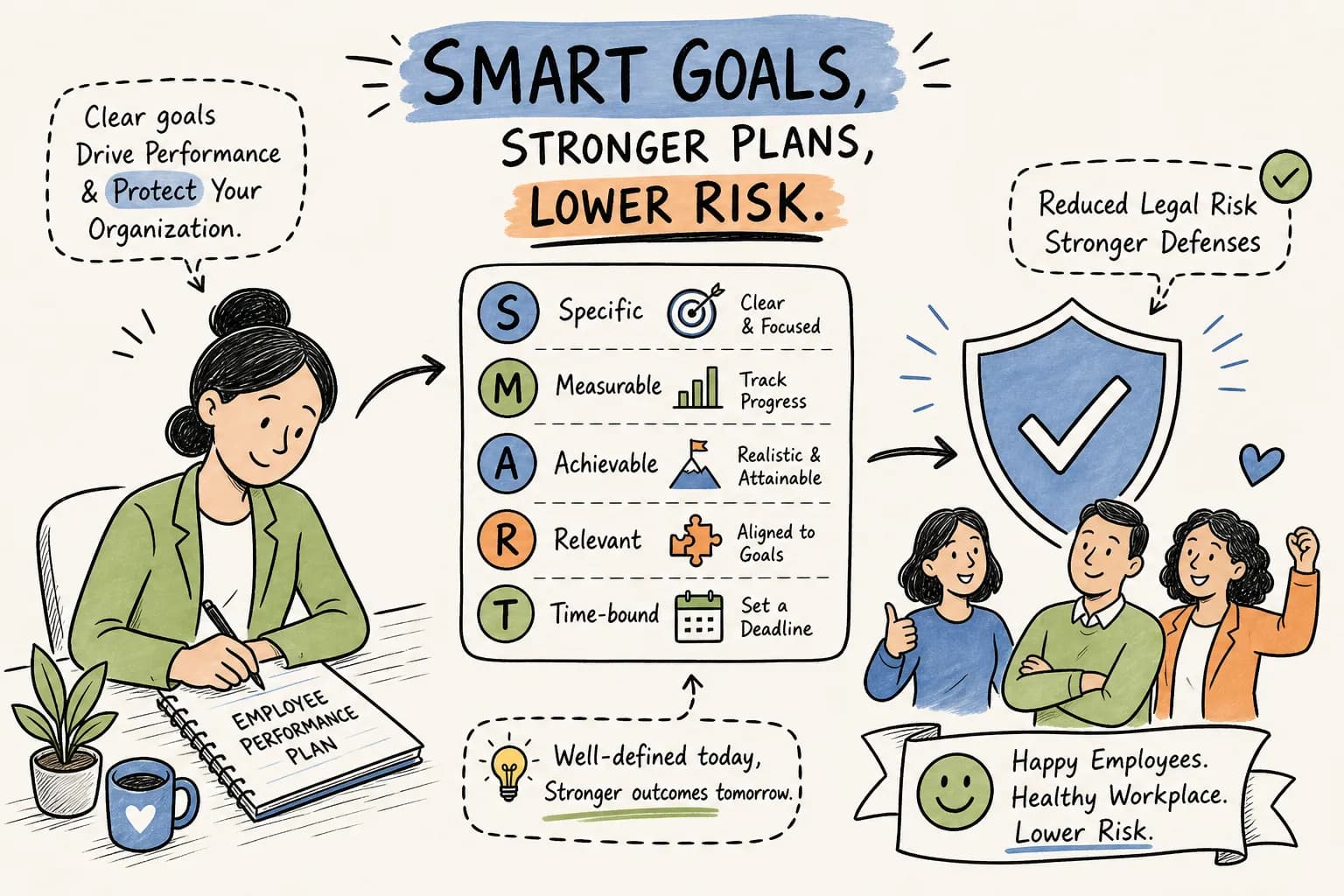
The S.M.A.R.T. criteria were originally developed as a management tool, but they map directly onto HR compliance needs. In a performance context, each letter carries specific weight. Specific means the goal names the exact behavior or output, the role responsible, and the standard required. Vague subjects like "communication" or "teamwork" don't qualify as specific. Measurable means the goal includes a KPI or observable indicator, not a feeling or impression. "Responds professionally to clients" isn't measurable. "Responds to client emails within four business hours, 90% of the time" is.
Achievable means the goal accounts for the employee's current skill level and the support available. A goal that requires skills the employee was never trained on won't hold up as a fair standard. Relevant ties the goal to the employee's actual job duties and the team's legitimate business needs. A warehouse employee's performance plan shouldn't include goals tied to executive reporting functions. Time-bound means the goal includes a clear deadline and a check-in schedule, not an open-ended expectation.
Common Variants HR Managers Should Know
The "A" and "R" in S.M.A.R.T. have the most historical variation. The original 1981 formulation used "Assignable" and "Realistic." Later adaptations shifted to "Achievable" and "Relevant." For HR compliance purposes, those two letters are also the ones most likely to be challenged in a dispute. An employee claiming the performance plan was designed for failure will point directly to whether the goals were achievable given their training and resources, and whether the goals were relevant to actual job expectations. Document your reasoning on both points when you write the goal, not just the goal itself.
How to Write SMART Goals for Performance Improvement Plans
Transforming a Vague Observation into a Trackable Goal
Here's what the before-and-after looks like in practice. Before: "Employee needs to improve response time to customer inquiries." This fails on every criterion. It names no standard, no metric, no timeframe, and no measurement method. After: "Respond to all inbound customer emails within four business hours, achieving a 90% compliance rate as tracked weekly in the CRM system, for 60 consecutive days beginning [date]." That rewrite reduces legal risk at every step. It names the exact behavior, quantifies success, sets a realistic standard, ties directly to a core job function, and includes a finite window with a built-in tracking mechanism.
Notice that the rewrite also removes any room for subjective interpretation. A manager can't quietly shift the standard mid-PIP because the standard is written down and attached to a data source. That consistency is exactly what protects both the employer and the employee.
State-Specific Considerations for California and Nevada Employers
In California, a performance improvement plan that precedes a termination carries significant weight in any subsequent dispute. The documentation needs to show that the employee received clear notice, had adequate time to improve, and was given genuine support. A PIP goal that is technically written but never followed up with coaching or resources undermines the employer's position. In Nevada, similar scrutiny applies. Courts and agencies in both states look for a consistent chain of evidence from expectation to evaluation to outcome.
For both states, your SMART goals should reference the specific job description criteria or company policy the employee is being measured against. That reference creates the direct link regulators look for: the employee knew the standard, the standard was tied to a real job requirement, and the measurement was objective. Without that link, you have a goal. With it, you have a defense.
SMART Goals for Onboarding and Compliance Training
Setting Measurable Milestones for New Hires
Onboarding is where structured goal-writing gets skipped most often. HR managers set up orientation schedules and hand new hires a stack of forms, but rarely write down measurable completion benchmarks. Here's what a well-written onboarding objective looks like: "Complete all four required compliance training modules in the company LMS with a passing score of 80% or higher within the first 30 days of employment." That goal creates a clean audit trail and establishes baseline documentation from day one. If a compliance question comes up later, you have timestamped proof that the employee was trained and assessed.
Compliance Training Timelines That Reflect State Law
California employers with five or more employees must provide harassment prevention training — two hours for supervisors, one hour for everyone else — within six months of hire or promotion, and every two years after that (Gov. Code § 12950.1(a)(1)). The requirement began with AB 1825 and was extended to nonsupervisory staff, at the five-employee threshold, by SB 1343. Below five employees, the mandate does not attach. Our California harassment prevention training guide walks the rule in more detail.
Short-tenure staff run on a tighter clock, and it is the deadline most often missed. For seasonal, temporary, or other employees hired to work less than six months, training is due within 30 calendar days after the hire date or within 100 hours worked, whichever occurs first (§ 12950.1(f)). Note that the test is the expected length of the engagement, not how long the person ends up staying. Where a temporary employee comes through a staffing agency, the same subdivision places the duty on the temporary services employer, not the client — an allocation worth confirming in the service agreement rather than assuming. Construction employers operating under a multiemployer collective bargaining agreement have a narrow exception in § 12950.1(l): they may rely on training the worker received within the past two years through a signatory employer or an approved apprenticeship program, so long as they verify it and train anyone whose verification cannot be obtained.
Nevada is not a mirror of that rule, and this is where multi-state employers get caught assuming it is. Nevada imposes no comparable statewide harassment-training requirement on private employers; its anti-discrimination obligations run through the Nevada Fair Employment Practices Act, NRS 613.330 and following, enforced by the Nevada Equal Rights Commission and applying at the 15-or-more-employee floor set by NRS 613.310(2). Training remains a sound evidentiary practice there — it is simply not a statutory deadline you can write into a goal. Where a deadline does exist, embed the statutory one directly rather than a generic internal timeline. For example: "Complete harassment prevention training required by Gov. Code § 12950.1 by [specific date, no later than six months from hire date], with a certificate of completion filed in the employee's personnel record."
That phrasing does two things at once. It turns a legal requirement into a documented, trackable objective, and it creates the paper trail regulators want to see if a complaint is ever filed. A vague goal like "complete required training" gives you nothing to show an investigator. A time-bound goal with a statutory reference gives you everything.
A Fill-in-the-Blank SMART Goal Template
A Structure HR Managers Can Copy and Use Today
Use this core template for performance reviews, improvement plans, and training objectives:
Template: "[Employee name/role] will [specific action or behavior] at a rate of [measurable standard] as tracked by [data source or method] by [deadline], with progress reviewed on [check-in cadence]."
Two completed examples using this SMART goal template:
- Performance improvement:"Maria Reyes, Customer Service Representative, will respond to all inbound customer emails within four business hours, achieving a 90% compliance rate as tracked weekly in Salesforce, by [date 60 days from plan start], with progress reviewed every Friday by her direct supervisor."
- Training completion:"All newly promoted supervisors will complete the two-hour harassment prevention training module in the company LMS with a certificate of completion, no later than six months from the date of promotion, with completion status verified by HR on the first of each month."
Both goals work equally well whether a manager, an employee, or an outside reviewer is reading them. That transparency matters, it's what separates documentation that looks fair from documentation that actually is fair, and that distinction is exactly what neutral third parties evaluate when a dispute lands on their desk.
Bilingual Documentation and What It Means for Your Workforce
California doesn't universally require employers to provide performance documentation in Spanish, but offering bilingual materials when your workforce includes Spanish-speaking employees is both a best practice and a meaningful risk-reduction strategy. An employee who didn't fully understand a performance expectation because it was only documented in English has a stronger argument in a dispute. Providing the same goal in Spanish, translated by a qualified professional, closes that argument before it starts.
Be clear about where that translation comes from: you commission it. State agencies publish some of their own required workplace notices in Spanish, and you should post the Spanish version the agency provides wherever your workforce needs it — but an agency's notice is not a translation of your employee's goal, and no template you download anywhere is either. Budget for a qualified translator the same way you budget for the LMS.
Mistakes That Turn Good Goals into Legal Liabilities
Confusing Activity with Outcome
"Complete eight training sessions" is an activity. "Demonstrate proficiency in the company's corrective action process by scoring 85% or higher on the post-training assessment within 45 days" is an outcome. In a legal challenge, the difference matters significantly. Activity logs show that something happened; outcome metrics show whether it worked. Documentation that only tracks activity gives an employee's attorney room to argue the employer never actually defined success, just motion.
No Review Cadence, No Legal Trail
A well-written goal that gets reviewed once at the start and once at the end of a PIP is nearly as problematic as no goal at all. Every performance objective should include a scheduled check-in: weekly for active improvement plans, monthly for developmental goals. Each check-in should produce a brief documented note that records progress against the measurable standard, the manager's feedback, and the employee's acknowledgment of that feedback. That paper trail, whether it lives in a physical file or an HRIS, is what allows an employer to demonstrate a fair and consistent process if a termination is ever challenged.
The check-in cadence also protects employees. When managers document progress regularly, employees know exactly where they stand. There are no surprises at the end of the review period, and that transparency is what distinguishes a fair performance management process from one that looks pretextual.
The Bottom Line on Defensible Performance Documentation
Specific, measurable SMART goals are not a management luxury in California and Nevada. They are a compliance strategy. When every performance expectation in your plans meets the S.M.A.R.T. criteria, you protect the employee's right to fair notice and you protect the employer's ability to make and defend personnel decisions. The two goals aren't in conflict. Good documentation serves both sides.
Start with one performance plan currently in use. Run it through the template structure from this article. Ask whether a neutral third party could evaluate the goal objectively without talking to anyone involved. If the answer is no, rewrite it until it is. That single exercise will surface the documentation gaps that create the most legal exposure in your organization.
HR World Today publishes free guides covering federal law and seven states — California, Nevada, Texas, Pennsylvania, Arizona, Utah, and Florida. If you're checking whether a headcount trigger like the five-employee training threshold applies to you, the HR compliance thresholds table collects them in one place with a downloadable CSV, and the per-state FAQs cover the questions that come up most. For a specific situation, the cited AI HR Assistant answers with the controlling statute attached, so the time-bound element in your goal is grounded in something you can point to rather than an internal guess. If what you want is a person to read the plans you are using and tell you what is wrong with them, that is consulting work — Maggie Vinas, the independent HR consultant whose practice is separate from HR World Today, is contracted directly for it.
Need this for a specific state?
This article covers the framework. The assistant answers a specific question about a specific state with the controlling statute attached, across California, Nevada, Texas, Pennsylvania, Arizona, Utah and Florida.
Ask the HR assistantGeneral information, not legal advice. Employment law varies by state and locality and changes over time — confirm against the governing statute before acting on it.