
Which HR laws apply as your headcount grows: a step-by-step checklist by employee count
10 min read · Published September 3, 2026
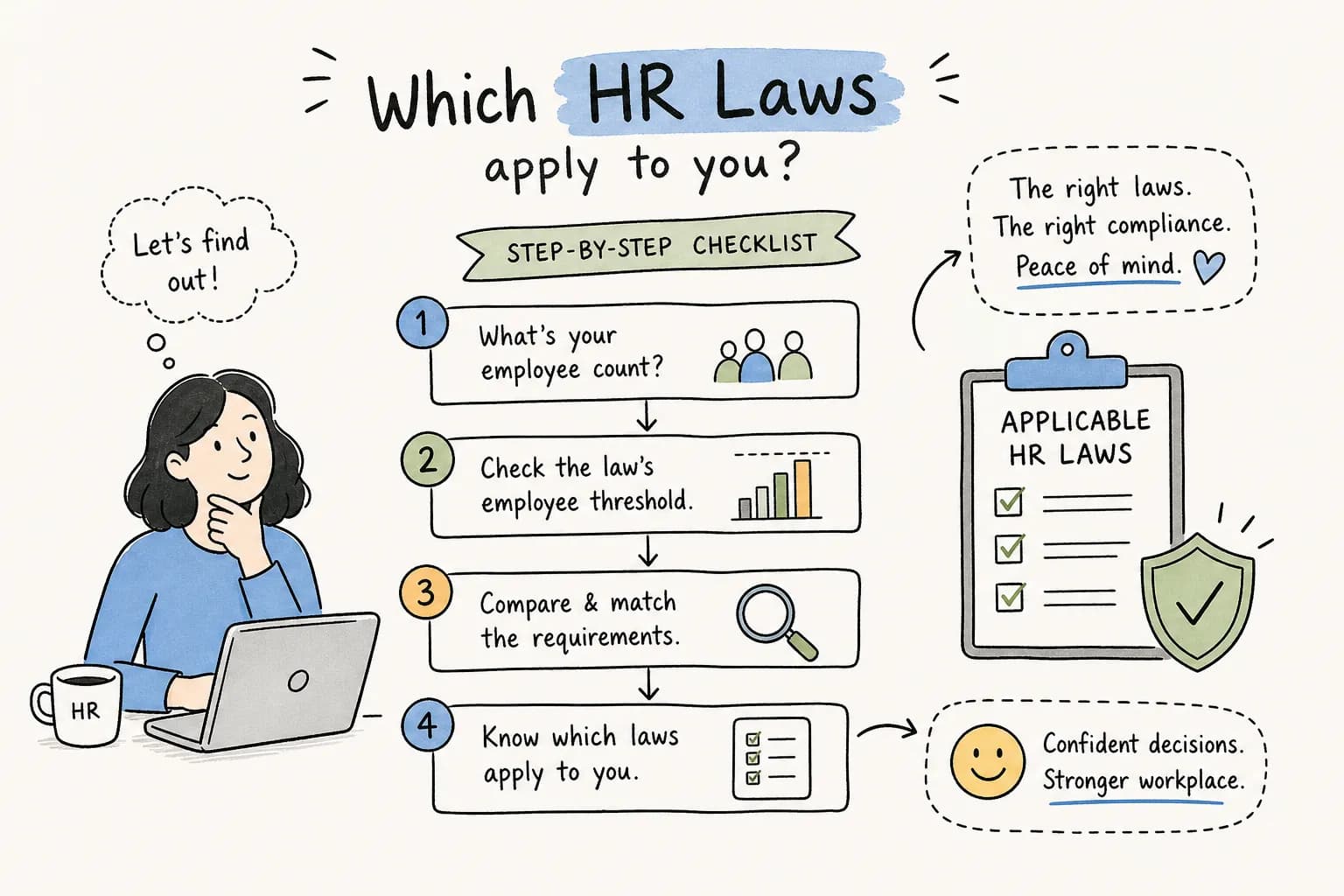
You have twelve people on payroll, two offers out, and a third requisition approved for the spring. Somebody in a leadership meeting asks whether "anything changes at fifteen." The honest answer is that a lot changes — but not on the number most people are counting, and not on the date they expect.
Employer-size thresholds look like the cleanest rule in employment law and behave like the opposite. Almost every one has its own counting method, its own measuring period, and its own definition of an employee. Two of the most important sit at the same headcount and are measured completely differently. And in several states obligations switch on well below the federal line — one of the seven states this site covers mandates paid sick time from the first employee.
The federal milestones at a glance
| Headcount | What switches on | How it is measured |
|---|---|---|
| 1 | FLSA, OSHA, USERRA, Form I-9, PUMP Act | No employee-count threshold at all |
| 15 | Title VII (incl. the PDA), ADA, GINA, PWFA | 15+ each working day in each of 20+ calendar weeks, current or prior year |
| 20 | ADEA and COBRA | Two different tests — see steps 9 and 10 |
| 50 | FMLA and the ACA employer mandate | 50 within 75 miles vs. 50 full-time equivalents |
| 100 | WARN 60-day notice, EEO-1 Component 1 | Part-timers counted differently in each |
A fuller version — with the state thresholds interleaved and a downloadable CSV — lives on the HR compliance thresholds table.
The checklist
From your first employee
- Wage and hour (FLSA). No headcount threshold. Coverage runs through enterprise coverage (generally $500,000+ in annual sales) or individual coverage of an employee engaged in interstate commerce (DOL Fact Sheet #14). Minimum wage, overtime after 40 hours, the exempt-salary and duties tests, and recordkeeping all apply on day one, as does the Equal Pay Act (29 U.S.C. § 206(d)).
- Safety (OSHA). The standards and the General Duty Clause apply to every employer; headcount changes only the paperwork. Employers with 10 or fewer employees the prior year are partially exempt from the injury and illness log (29 C.F.R. § 1904.1) — but all employers report a fatality within 8 hours and a hospitalization, amputation or eye loss within 24 (29 C.F.R. § 1904.39).
- Military leave and reemployment (USERRA). Applies to every employer regardless of size, with no minimum length of service (20 C.F.R. § 1002.34).
- Form I-9 (IRCA). Verify identity and work authorization for every new hire; no employer-size threshold (USCIS Form I-9). The anti-discrimination provision at 8 U.S.C. § 1324b is a different statute with a split threshold: citizenship-status claims reach employers of 4 or more, while unfair documentary practices and retaliation reach an employer of any size (28 C.F.R. § 44.200).
- Lactation breaks (PUMP Act). Reasonable break time and a private, non-bathroom space for up to one year after birth. One carve-out: an employer with fewer than 50 employees is exempt if compliance would impose an undue hardship — a fact-specific defense, not an exemption you claim by headcount (DOL Fact Sheet #73).
At 15 employees
- Title VII, and through it the Pregnancy Discrimination Act — a definitional amendment rather than a separate statute, so it carries the same threshold. The test: 15 or more employees for each working day in each of 20 or more calendar weeks in the current or preceding calendar year (42 U.S.C. § 2000e(b)).
- ADA — disability non-discrimination, the reasonable-accommodation duty and the interactive process, with the identical 15-employee/20-week definition (42 U.S.C. § 12111(5)).
- GINA Title II (29 C.F.R. § 1635.2) and the PWFA (42 U.S.C. § 2000gg) borrow Title VII's employer definition, so all four arrive together — the single biggest step-change in the federal scheme.
At 20 employees — two thresholds, two different tests
- ADEA (age 40+) uses Title VII's structure with a different number: 20 or more employees for each working day in each of 20 or more calendar weeks, current or preceding year (29 U.S.C. § 630(b)).
- COBRA sits at the same headcount and is measured nothing like it. A plan is a small-employer plan — outside COBRA — only if the employer "normally employed fewer than 20 employees" in the preceding calendar year, meaning it had fewer than 20 on at least 50 percent of its typical business days that year. Each full-time employee counts as one; each part-timer counts as a fraction of hours worked over hours required for full-time status. Self-employed individuals, independent contractors and corporate directors are not counted (26 C.F.R. § 54.4980B-2, Q&A-5). So "we have eighteen people" answers the ADEA question and not the COBRA one. Below the federal line a state mini-COBRA may fill in — Arizona, Utah, Florida and California each have one. Nevada does not: its continuation statutes were repealed effective January 1, 2014, so charts still listing Nevada describe dead law. Never quote the federal 102% premium ceiling for a mini-COBRA plan; each state sets its own.
At 50 employees
- FMLA is two tests, and employers routinely announce the wrong one. The employer is covered at 50 or more employees for each working day in each of 20 or more calendar workweeks, current or preceding year (29 C.F.R. § 825.105). An individual employee is eligible only if the employer employs 50 or more within 75 miles of that employee's worksite, plus 12 months of service and 1,250 hours in the prior year (29 C.F.R. § 825.111). A 60-person employer spread across three distant sites is a covered employer with ineligible employees.
- ACA employer mandate. Not a headcount at all: it is full-time employees plus full-time equivalents, averaged over the preceding calendar year. Full time means 30 or more hours of service per week, or 130 hours in the month. For FTEs, take every non-full-time employee's monthly hours, counting no more than 120 per person, and divide by 120 — never by 130. Add the 12 monthly totals of full-time employees and FTEs, divide by 12, drop the fraction. Fifty or more makes you an applicable large employer for the following year (26 C.F.R. § 54.4980H-2; IRS ALE guidance). Dividing by 130 undercounts your FTEs and can quietly put you over the line.
At 100 employees
- WARN. Sixty days' written notice before a plant closing or mass layoff, from employers with 100 or more employees excluding part-time employees, or 100 or more including part-timers who together work at least 4,000 hours a week exclusive of overtime (20 C.F.R. § 639.3). Several states add a mini-WARN with a lower trigger; among the seven covered here, only California does.
- EEO-1 Component 1. Private employers with 100 or more employees file the annual demographic report (29 C.F.R. § 1602.7) — a Title VII requirement that stands on its own and says nothing about contractors. The separate 50-employee federal-contractor tier is the one to be careful about. It rested on Executive Order 11246, revoked by E.O. 14173 on January 21, 2025, and on 41 C.F.R. § 60-1.7, which OFCCP rescinded by final rule effective October 26, 2026. That rule expressly says it "does not impact EEOC's actions with respect to the EEO-1 report," and the EEOC still applies the tier: its July 2026 rulemaking states in the present tense that EEO-1 requirements "apply to private employers with 100 or more employees and to federal contractors that have 50 or more employees and meet certain criteria." A contractor with 50 to 99 employees should not read the revocation as removing the trigger — keep the demographic data collectable and work from the EEOC's current instructions. Nothing is due at the moment in any event: the 2024 collection is closed, no 2025 cycle has opened, and a proposed rule would end EEO-1 reporting altogether.
Three counting traps
"Twenty calendar weeks" is not "twenty weeks in a row," and it includes last year. Seasonal and cyclical employers cross Title VII and the ADEA and stay across for a full extra year, because the test reads current or preceding year (42 U.S.C. § 2000e(b)).
Controlled groups aggregate. For the ACA mandate, all entities treated as a single employer under I.R.C. § 414(b), (c), (m) and (o) are combined for the 50-FTE determination (26 C.F.R. § 54.4980H-1), and the same aggregation applies to the COBRA count (26 C.F.R. § 54.4980B-2). Common ownership across several small LLCs is the fact pattern that surprises people most.
Who counts is not obvious. Independent contractors, corporate directors and partners are generally excluded — but a misclassified contractor is an employee for threshold purposes too, so a classification problem quietly becomes a coverage problem.
Where state law starts lower
These seven states do not fall into "California" and "everyone else." Their thresholds sit at different numbers, and three reach an employer with one employee.
California is the lowest floor and the most commonly misstated. FEHA harassment liability applies to an employer regularly employing one or more persons, including harassment by non-employees (Gov. Code § 12940(j)). It is FEHA discrimination, and the § 12940(k) duty to take reasonable steps to prevent harassment, that take the five-employee definition at Gov. Code § 12926(d). "FEHA applies at five" understates a tiny employer's harassment exposure. CFRA is also 5+ (Gov. Code § 12945.2), so a 30-person California employer answers to CFRA, not FMLA. Cal-WARN triggers at a 75-employee establishment, defined in Lab. Code § 1400.5, not § 1400.
Arizona mandates earned paid sick time from the first employee (A.R.S. § 23-372) — headcount sets only the annual cap, 40 hours at 15+ and 24 below — and requires E-Verify of all employers (A.R.S. § 23-214); see the Arizona earned paid sick time guide. Arizona Civil Rights Act discrimination sits at 15+ (A.R.S. § 41-1461), its harassment provisions reach 1+, and its equal-pay statute has no threshold at all (A.R.S. § 23-341).
Nevada runs the other direction: statewide paid leave usable for any reason begins at 50 employees in Nevada (NRS 608.0197), employers in their first two years exempt. The Pregnant Workers' Fairness Act applies at 15+ (NRS 613.4353); domestic-violence leave has no employer-size floor, though the employee needs 90 days of service (NRS 608.0198).
Pennsylvania starts discrimination coverage at 4 employees under the Human Relations Act, well below the federal 15 (43 P.S. § 954(b)), and layers three separate local paid-sick-leave regimes on top: Philadelphia, paid at 10+ employees and unpaid below (Phila. Code ch. 9-4100); Pittsburgh, all sizes, with headcount setting only the annual cap (Pittsburgh Code ch. 626); and Allegheny County at 26+, which yields to a stricter municipal ordinance (Allegheny County Health Department). See the Pennsylvania local paid sick leave guide.
Florida has thresholds at 4 (workers' comp; construction 1+ — Fla. Stat. § 440.02), 10 (Whistleblower's Act), 15 (Florida Civil Rights Act), 25 (mandatory E-Verify) and 50 (domestic-violence leave).
Texas tracks the federal map at 15+ under Chapter 21 of the Labor Code for private employers — a county, municipality, state agency, or state instrumentality is covered at any size (§ 21.002(8)(D)) — with one large exception: since 2021 sexual-harassment liability reaches employers with one or more employees and can attach to individuals personally (Tex. Lab. Code § 21.141). Workers' compensation is optional at any size (§ 406.002).
Utah is closest to the federal thresholds — antidiscrimination at 15+ (Utah Code § 34A-5-106) — and caps non-competes at one year at any size (§ 34-51-201). Its E-Verify mandate currently reads 150+ (§ 13-47-201), but confirm it against the current code: the chapter has moved up from an original 15-employee threshold and carries a contingent repeal.
What to do next
Pull headcounts for each of the last 24 months, not just today's, and run three counts against them: the 20-calendar-week test, the COBRA 50-percent-of-typical-business-days test, and the ACA full-time-plus-FTE average. Then map your worksites for the FMLA 75-mile radius and list every commonly owned entity to check aggregation. Do it before you cross a line — most of these tests look backward at a year you can no longer change. To pressure-test a count or a state overlay, the assistant will work through it with citations to the controlling statute.
This article is general information, not legal advice. Verify every figure against the primary source before making a compliance decision, and take fact-specific questions to an employment attorney licensed in your state.
Need this for a specific state?
This article covers the process. The assistant answers a specific question about a specific state with the governing statute attached, across California, Nevada, Texas, Pennsylvania, Arizona, Utah and Florida.
Ask the HR assistantGeneral information, not legal advice. Employment law varies by state and locality and changes over time — confirm against the governing statute before acting on it.