
Final paycheck rules compared across California, Nevada, Texas, Pennsylvania, Arizona, Utah and Florida
10 min read · Published September 3, 2026
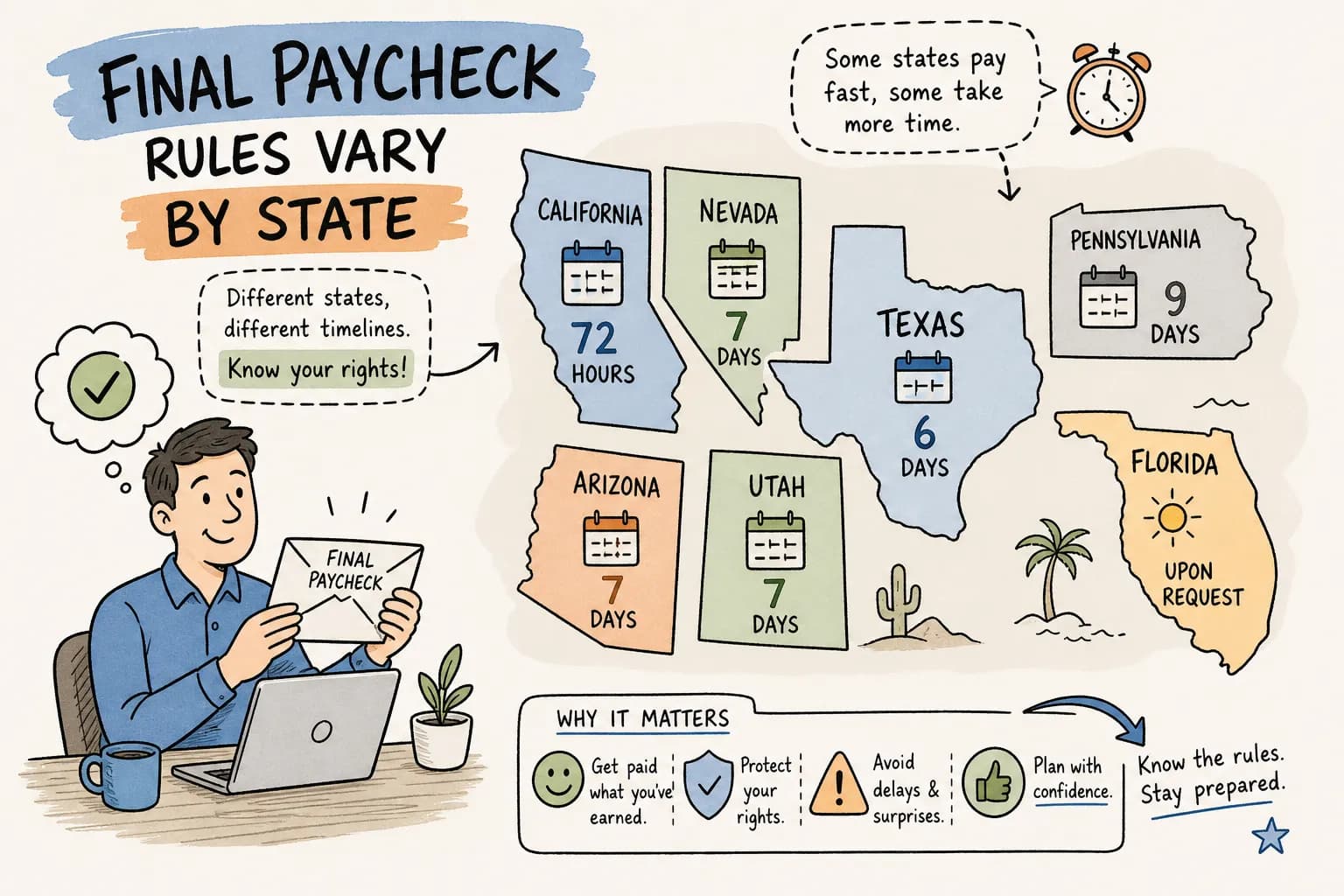
A manager calls at 3:40 on a Friday. The termination meeting is at 4:00, and the question is the one that always comes last: when does the check have to be ready? In one state that is a lookup. Across several it is seven different answers, and the wrong one is expensive in a way that has nothing to do with the size of the underlying paycheck.
Final pay is the most mechanical rule in employment law and one of the most frequently misstated, because the deadlines look similar enough to blur together. Below are the seven states this site covers, with the deadline tied to separation type — in five of the seven, it changes depending on whether the employee was fired or quit.
The seven deadlines, side by side
| State | Discharge / involuntary | Quit or resign | Accrued vacation or PTO | Penalty for late payment | Governing statute |
|---|---|---|---|---|---|
| California | Immediately, at the place of discharge | Last day if 72+ hours' notice was given; otherwise within 72 hours | Vested vacation at the final rate — but only where a contract or policy provides paid vacation | Waiting-time penalty up to 30 days' wages, and only for a willful failure | Lab. Code §§ 201, 202, 203, 208, 227.3 |
| Nevada | Immediately — including a move to "nonworking status" | Earlier of the next regular payday or 7 days | No statutory payout; payout of state paid leave is expressly optional | Up to 30 days' continuing wages, with a 3-day grace on discharge and none on resignation | NRS 608.020, 608.030, 608.040 |
| Texas | Not later than the sixth day after discharge | Next regular payday | No statutory entitlement; vacation pay is "wages" only if owed under a written agreement or policy | Administrative wage claim to the TWC; no automatic per-day penalty | Tex. Labor Code § 61.014 |
| Pennsylvania | Next regular payday | Next regular payday | No statutory entitlement, but a promised vacation benefit is a recoverable wage supplement | Liquidated damages of 25% or $500, whichever is greater, plus fees | 43 P.S. § 260.5 (Act 329 of 1961) |
| Arizona | Seven working days or the end of the next regular pay period, whichever is sooner | Regular payday for the pay period in which the termination occurred | No statutory entitlement; policy governs | Treble damages available but discretionary; a good-faith dispute is a defense | A.R.S. § 23-353, § 23-355 |
| Utah | Within 24 hours, unconditionally | Next regular payday | No statutory entitlement; PTO is wages only if due under an agreement or policy | Continuing wages, but the penalty accrues only after a written demand | Utah Code § 34-28-5 |
| Florida | No state deadline | No state deadline | No statute at all | None — an ordinary contract claim | No final-pay statute; Fla. Stat. § 448.110 reaches only the minimum-wage rate |
Florida is the genuine blank. It has no final-paycheck statute and no private-sector payday-frequency statute either, so there is no state deadline to miss and nothing behind it but the contract, the written policy, or a consistent past practice. Do not quote a Florida number; there isn't one to quote.
Three deadlines that are routinely misremembered
Nevada is immediate, not three days
This is the most common error in the set, and it comes from reading the penalty statute as the payment statute. NRS 608.020 says a discharged employee's earned wages are due immediately. The three days people remember live in NRS 608.040(1)(a), which is the trigger for the penalty, not the deadline for the payment. An employer that pays on day two is late under 608.020 and simply owes no penalty for being late.
Nevada also widened the immediate duty in 2023: the same obligation now attaches when an employer places an employee on "nonworking status" — a temporary layoff where the employee stays on the books and may be recalled (NRS 608.020). Employers running seasonal or furlough-style reductions miss this regularly, because it does not feel like a termination. The Nevada final paycheck guide walks through both paths.
Arizona is not "next payday"
A.R.S. § 23-353(A) requires payment of a discharged employee "within seven working days or the end of the next regular pay period, whichever is sooner." Both halves matter. If the pay period closes on Wednesday and the discharge happens Monday, seven working days is not available — the pay-period end governs, and paying on day seven is late. A payroll calendar that quietly routes every termination to the next scheduled run will be late in Arizona whenever the pay period closes first, and nothing about the run will look unusual.
For a quit, Arizona is the softer rule: § 23-353(B) sets the regular payday for the pay period during which the termination occurred.
Utah's 24 hours is not conditional on a request
Utah Code § 34-28-5(1)(a) requires payment within 24 hours of an involuntary separation, full stop. A written demand from the employee matters only to the penalty — under § 34-28-5(1)(b) it is what starts continuing wages accruing. It has never been what starts the payment clock; an employer that waits to be asked is already in breach. Utah's resignation rule is the ordinary one: next regular payday. The Utah final paycheck guide works through the demand mechanics.
What has to be in the check
The deadline is only half the compliance question. The other half is what the check must contain, and across six of these seven states the honest answer is: whatever the employer promised in writing.
California is the exception, and even there the entitlement is conditional. Lab. Code § 227.3 requires payment of vested vacation at the employee's final rate — but only "whenever a contract of employment or employer policy provides for paid vacations," and only unless a collective bargaining agreement provides otherwise. California does not require an employer to offer vacation at all, and an employer with no vacation benefit owes no § 227.3 payout.
The other six states create no statutory payout entitlement. What they create is enforceability once a promise exists:
- Utah is the most explicit. Utah Admin. Code R610-3-4(B)(1) extends "wages," for wage-claim purposes, to vacation, holiday, sick leave, PTO, severance and bonuses — but only if due under an agreement with the employer or under a policy of the employer. Where the policy does make it due, it becomes wages subject to the hard 24-hour deadline. A payout promise in a handbook converts into a same-day obligation.
- Pennsylvania's Wage Payment and Collection Law defines "fringe benefits or wage supplements" to include vacation pay (43 P.S. § 260.2a), so a promised vacation benefit is a recoverable wage. A use-it-or-lose-it forfeiture is enforceable only where the written policy states the forfeiture condition clearly before the time is earned; an ambiguous policy is read against the drafter.
- Texas counts vacation, holiday, sick, parental and severance pay as wages only where they are owed under a written agreement or a written policy (Tex. Labor Code § 61.001(7)(B)). An unwritten past practice is much weaker footing in Texas than in Florida, where past practice is the whole theory.
- Nevada goes further in the employer's direction on its own paid-leave statute: NRS 608.0197(1)(i) provides that an employer may, but is not required to, compensate an employee for unused paid leave at separation. But if the employee is rehired within 90 days and the separation was not a voluntary quit, the unused hours must be reinstated.
- Arizona and Florida leave it entirely to contract and policy.
Penalties, and the conditions people drop
Penalty exposure is where secondhand advice is least reliable, because these penalties are almost never automatic on lateness.
California waiting-time penalties require willfulness. Section 203(a) reaches only an employer who "willfully fails to pay," so a genuine good-faith dispute over the amount owed defeats the penalty; an employee who secretes or absents themselves to avoid payment is not entitled to it for that period either. The ceiling of 30 days' continuing wages is real, but it is not a late fee that attaches the moment the deadline passes.
Nevada's penalty trigger differs by separation type, and the direction surprises people. A discharged employee's penalty under NRS 608.040(1)(a) starts only if the employer fails to pay within three days after the wages become due. An employee who resigns gets no grace at all — 608.040(1)(c) triggers on the day the wages are due. The quitting employee's penalty therefore starts three days sooner than the fired employee's. Once triggered, the penalty back-dates: it runs at the employee's rate from the separation day, not from the trigger day, for up to 30 days.
Arizona's treble damages are discretionary. A.R.S. § 23-355 permits recovery of three times the unpaid wages, but the multiplier rests with the trial court and requires proven actual damages, and a reasonable good-faith dispute is a defense (Apache East, Inc. v. Wiegand, 119 Ariz. 308, 312–13 (App. 1978), adopted by the Arizona Supreme Court in Schade v. Diethrich, 158 Ariz. 1, 11 (1988)). Separately, § 23-353(D) makes a violation of the final-pay section a petty offense.
Pennsylvania attaches liquidated damages of 25% of the total wages due or $500, whichever is greater, plus attorney's fees (43 P.S. § 260.10). Texas routes the dispute to a wage claim with the Texas Workforce Commission rather than a per-day penalty (Tex. Labor Code § 61.051). Florida has neither — with no wage-payment statute in ch. 448 to enforce, the departing employee's remedy is an ordinary breach-of-contract action.
Delivery: the clause that hides in plain sight
Three of these states put a delivery obligation inside the payment statute, and two are conditional on the employee asking — which is why they get missed.
- California requires payment at the place of discharge — a rule that lives in Lab. Code § 208, not in §§ 201–203. Mailing a check to an employee terminated in the office does not satisfy an immediate-payment duty.
- Pennsylvania's 43 P.S. § 260.5(a) requires that payment be made by certified mail where the employee so requests.
- Arizona's § 23-353(B) carries the parallel clause for a quit: "If requested by the employee, such wages shall be paid by mail."
A termination checklist that captures the deadline but not the delivery method is still incomplete in three of seven states.
What to do
Put the deadline in the separation approval, not the payroll run. Three facts decide the answer before the meeting is scheduled: the state, whether the separation is voluntary, and whether the written policy promises a PTO payout. In California, Nevada and Utah that combination can mean the check has to exist before the conversation happens, which means payroll needs notice days earlier than the manager assumes. Audit the vacation language in the handbook now rather than during a separation — in six of these seven states the handbook is the entitlement, and the afternoon it becomes a wage claim is the wrong time to discover an ambiguous forfeiture clause. And when the facts get unusual — commissions, a genuinely disputed amount, a temporary layoff, one of California's industry-specific carve-outs (temp services, motion picture, live theatrical, oil drilling) — read the statute rather than the summary. You can put a state-specific question to the assistant and get an answer with the governing section cited, and the California final paycheck guide covers that state's carve-outs in more depth.
This article is general information, not legal advice. Verify every figure against the primary source before making a compliance decision, and take fact-specific questions to an employment attorney licensed in your state.
Need this for a specific state?
This article covers the process. The assistant answers a specific question about a specific state with the governing statute attached, across California, Nevada, Texas, Pennsylvania, Arizona, Utah and Florida.
Ask the HR assistantGeneral information, not legal advice. Employment law varies by state and locality and changes over time — confirm against the governing statute before acting on it.