
How to audit payroll for minimum wage compliance: a step-by-step checklist for small employers
11 min read · Published September 2, 2026
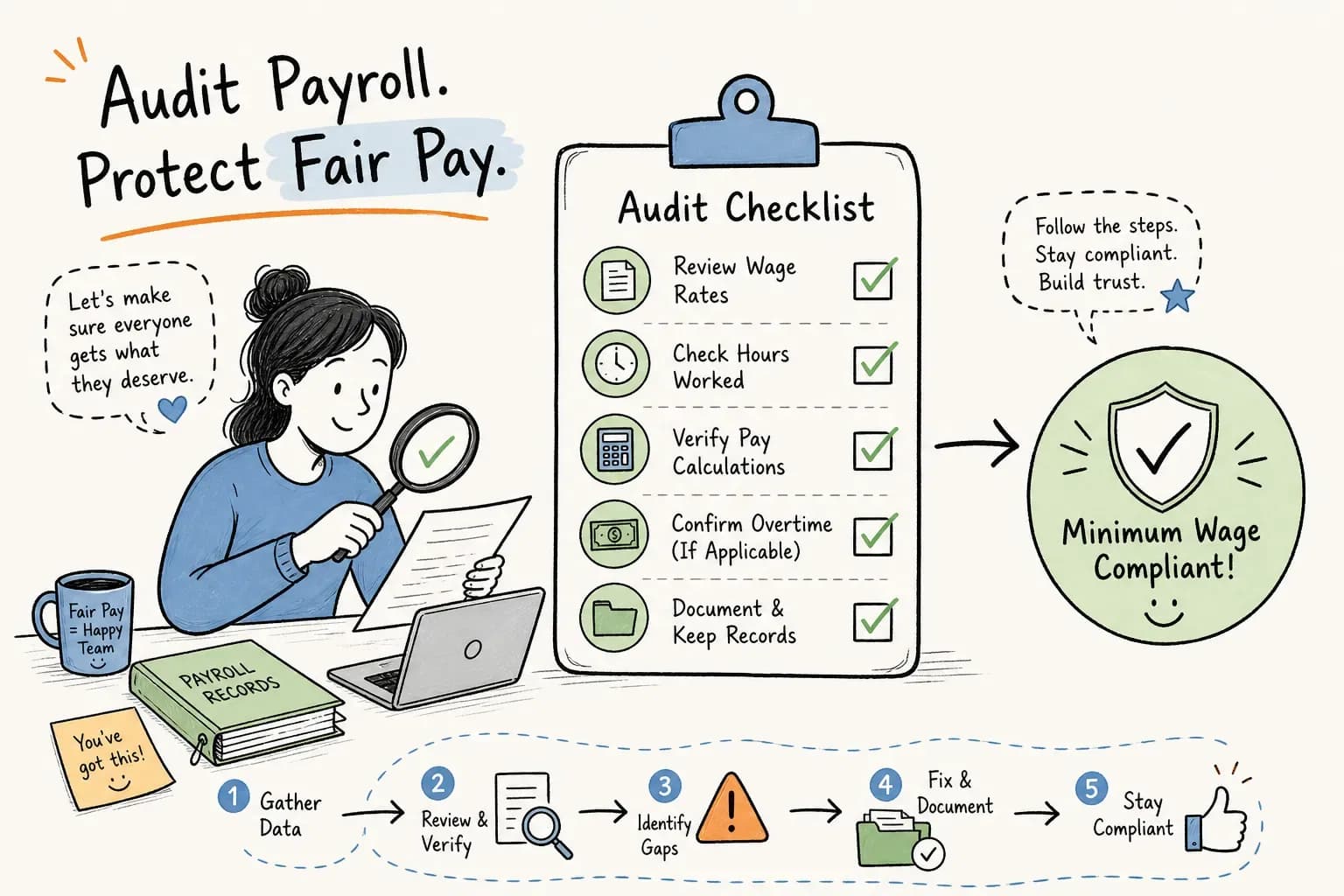
Florida's minimum wage moves on September 30, not January 1. A payroll system set once a year can run last year's rate for months, and the shortfall accrues quietly until someone points it out. Minimum wage compliance in 2026 is not one number. It is a federal floor, a state rate that may sit above it, and in two of the seven states HR World Today covers, city rates that sit above the state. Tipped employees follow different rules by state, and California and Nevada allow no tip credit at all. This article walks through the current rates across those seven states, the interactions employers most often miss, and a nine-step checklist to run before your next pay period.
What "minimum wage" actually means for payroll
The three-layer wage rule every employer must follow
The wage floor works as a hierarchy: the federal FLSA sets the baseline at $7.25 per hour, state law overrides that with a higher rate where one exists, and local ordinances override both if the city or county sets something higher still. The highest applicable rate controls. Across the seven states, local minimum wages exist only in California and Arizona. Texas (Labor Code § 62.0515) and Florida (Fla. Stat. § 218.077) bar cities and counties from setting their own rate for private employers, and no local rate is in effect in Nevada, Pennsylvania, or Utah.
A Texas employer pays $7.25, because Texas adopts the federal floor. A California employer pays $16.90 statewide regardless of what the federal floor says. An employer with workers in unincorporated Los Angeles County pays $18.47 starting July 1, 2026, because that local ordinance sits above the state rate. The practical lesson: your payroll rate is determined by where employees physically work, not by where your business is registered or headquartered.
When employer size, revenue, or industry changes the rate you owe
Small businesses sometimes assume they qualify for a lower rate because of their size. None of the seven states covered here sets a lower general minimum wage for small employers, so in these states the assumption is wrong. Headcount changes other obligations — that is what the headcount threshold table is for — but not the wage floor.
California adds industry-specific rates on top of the statewide minimum. Fast food workers earn $20.00 per hour under state law, and certain health care workers reach rates as high as $25.00 per hour depending on facility type. If your business falls into one of those categories, the general $16.90 statewide rate is not your number.
2026 minimum wage rates in HR World Today's seven states
Rates already in effect as of January 1, 2026
Here are the baseline minimum wage rates for each of the seven states HR World Today covers. Each state name links to its guide, which carries the current figure, its source, and the next scheduled change.
| State | 2026 rate | Notes |
|---|---|---|
| California | $16.90/hr | Statewide, most employers; industry-specific rates apply in some sectors |
| Nevada | $12.00/hr | Fixed rate; no tip credit allowed |
| Texas | $7.25/hr | Federal floor; no state minimum above federal |
| Pennsylvania | $7.25/hr | Federal floor; no state minimum above federal |
| Arizona | $15.15/hr | Statewide; Flagstaff ($18.35) and Tucson ($15.45) set higher local rates |
| Utah | $7.25/hr | Federal floor; no state minimum above federal |
| Florida | $14.00/hr through Sept. 29; $15.00/hr from Sept. 30 | Mid-year increase effective September 30, 2026 |
Pennsylvania, Texas, and Utah all default to the federal floor because none has enacted a higher statewide minimum wage. For employers in those states, the rate is straightforward. California and Arizona adjust their rates every January, and both have cities above the state rate, so employers there need an active tracking step. Nevada's $12.00 is fixed; it changes only if the Legislature acts.
Mid-year rate changes and the dates that matter most
Florida's increase to $15.00 per hour takes effect on September 30, 2026, not January 1, and the tipped cash wage moves with it, from $10.98 to $11.98. Hours worked on or after September 30 are paid at the new rate even when the pay period straddles the date, so the payroll change and the replacement poster (Fla. Stat. § 448.109) both need to be in place before that pay period begins, not on the day.
Local ordinances that override your state rate
Arizona has two. Flagstaff's minimum wage is $18.35 per hour effective January 1, 2026, and from that date Flagstaff no longer allows a lower cash wage for tipped employees. Tucson's is $15.45 for 2026. An Arizona employer with workers in either city owes the city rate, not $15.15, for every hour worked within city limits. California's local landscape is more layered: as of July 1, 2026, Los Angeles City is $18.42, unincorporated Los Angeles County $18.47, San Francisco $19.61, and Emeryville $20.34.
Local compliance is a separate check from state compliance. Even if your payroll system correctly applies the state rate, it won't automatically catch a city ordinance unless someone configures it to do so. If any of your employees work in a jurisdiction with a local minimum wage, that rate controls for those employees, even if your company headquarters is in a different city.
How wage increases interact with overtime, exempt status, and tipped-employee pay
Tip credit rules and minimum wage interaction by state
The federal tipped minimum wage is $2.13 per hour. The employer pays that lower cash wage, and the employee's tips are expected to bridge the gap up to the full minimum. Several states follow a similar structure, but with different numbers. Arizona sets the tipped minimum at $12.15 per hour versus the standard $15.15, giving employers a $3.00 tip credit (A.R.S. § 23-363(C)). Florida's tipped minimum is $10.98 per hour, with a $3.02 tip credit against the $14.00 state minimum. Florida's tipped rate rises to $11.98 on September 30, 2026. Arizona's $3.00 credit does not apply in Flagstaff, where the tip credit ended January 1, 2026.
California and Nevada are exceptions: both states prohibit tip credits entirely. California employers must pay the full $16.90 per hour regardless of how much an employee earns in tips. Nevada employers must pay the full $12.00. Applying a federal-style tip credit to California employees creates an automatic violation for every tipped employee, every pay period it goes uncorrected.
When a wage increase turns an exempt employee non-exempt
California ties its exempt salary floor directly to the state minimum wage. The formula is straightforward: the minimum annual salary for a standard executive, administrative, or professional exemption equals twice the state minimum wage for a 40-hour week across 52 weeks (Labor Code § 515). At $16.90 per hour, that works out to $70,304 per year in 2026. An exempt employee earning less than that amount doesn't qualify for the exemption, regardless of their job duties.
Employers who set an exempt salary in a prior year and haven't reviewed it since the last rate increase may be misclassifying workers without realizing it. That misclassification creates overtime liability for every week the employee worked more than 40 hours. Every time California's minimum wage rises, the exempt salary threshold rises with it. A compliance calendar that tracks wage increases needs to include a classification review as a linked step.
Sub-minimum wages and when they legally apply
The federal youth wage lets an employer pay $4.25 per hour to an employee under 20 for the first 90 consecutive calendar days of employment. No certificate is required, but no existing employee may be displaced to make room (FLSA § 6(g)). Full-time students, student-learners, and workers with disabilities may be paid below the minimum only under a certificate issued by the Department of Labor before the arrangement starts. State law can be stricter: California has no youth subminimum wage. Most small employers won't use any of these provisions.
If you have any arrangement in place that pays below the standard minimum wage, confirm the required documentation is on file and current. Your payroll audit checklist should include a quick verification that no sub-minimum arrangement exists without proper authorization, because an undocumented arrangement looks, in an audit, exactly like a wage violation.
The payroll audit checklist: nine steps to run before your next pay period
Steps 1–3: Confirm the correct rate applies to every employee
- Pull the minimum wage rate for each jurisdiction where employees physically work, not where the business is headquartered. A remote employee working from Los Angeles is owed the LA city rate, not the rate at your main office.
- Verify the effective date of the current rate and confirm no mid-year increase has been missed. Florida changes on September 30; California and Arizona change on January 1.
- Cross-check every employee's base hourly rate or salary equivalent against the applicable wage floor for their work location. This comparison needs to happen at the individual employee level, not as a batch average.
Steps 4–6: Review classifications, tip arrangements, and deductions
- Review every tipped employee's pay to confirm that tips plus cash wages meet or exceed the applicable minimum wage for each individual workweek, not as a monthly or quarterly average. A shortfall in any single workweek is a violation.
- Verify that every exempt employee meets the current salary threshold for their state after any rate increase. For California employers, confirm the annual salary is at or above $70,304.
- Audit all deductions for uniforms, tools, or meals to confirm they don't pull an employee's effective hourly rate below the wage floor. Deduction errors don't show up in the base pay line, which is why they go unnoticed.
Steps 7–9: Documentation and recordkeeping check
- Confirm payroll records showing hours worked, gross wages, and deductions are kept at least three years (29 CFR 516.5), with time cards and wage-computation records at least two (29 CFR 516.6). California's own rule is three years (Labor Code § 1174(d)) and Nevada's is two (NRS 608.115); the federal period is the longest of the three.
- Check that required minimum wage posters are displayed at every work location, including remote or satellite offices. A stale poster is a technical posting violation even when you're paying the correct rate, and it's an easy item for a labor inspector to flag.
- In California, confirm each non-exempt employee received the Labor Code § 2810.5 notice at hire, and that any later rate change appeared on a timely wage statement or in a separate written notice within seven calendar days. The notice goes out in the language the employer normally uses to communicate employment information to that employee. In the other six states, check the state guide before assuming a separate notice is required; for most, the poster and the pay statement are the obligations.
Required notices, handbook updates, and documentation that protect you in an audit
What your posting obligations look like after a rate increase
Every worksite must display the current federal and state minimum wage poster. When the rate increases, the old poster must come down and the new one go up on the effective date of the change. California's Labor Code § 2810.5 requires a written notice to each non-exempt employee at hire, and notice of any change within seven calendar days, unless the change is reflected on a timely wage statement, which satisfies the requirement. The poster obligation is separate. Employers in the other six states should confirm their own notice rules in the state guide.
Employers who update payroll but forget to replace the poster face a technical posting violation. That sounds like a minor infraction until a state labor inspector or plaintiff's attorney cites it as evidence of a broader pattern of non-compliance. The posting obligation is a straightforward compliance item; it just needs to be on the checklist alongside the payroll update.
Handbook policy language and written wage notices: what to include
In California, the § 2810.5 notice must show the rate or rates of pay and their basis (hourly, salary, piece rate), any allowances claimed against the minimum wage, the regular payday, the employer's legal name and address, and the workers' compensation carrier, along with the paid sick leave statement. A rate-change notice can be shorter, but it should still show the new rate, its basis, and the effective date. The Labor Commissioner publishes the notice template in English and Spanish. Your employee handbook's wage-and-hour section should reference the applicable law and note that the company follows the highest applicable rate, which protects you if local ordinances change after the handbook was printed. HR World Today's AI HR Assistant answers wage-notice questions for each of the seven states and cites the governing law in every answer.
What to do when your audit uncovers a gap
Fixing the error before it becomes a claim
If you find an underpayment, the correction process is straightforward: calculate the shortfall for each affected employee, issue correction pay in the next regular payroll cycle or sooner if state law requires faster remediation, and place a written memo documenting the error and correction in the employee's file. Self-correcting quickly and documenting it reduces your exposure if a complaint is filed later.
Never retroactively adjust time records to reduce hours on paper. Doing so can convert a wage violation into a separate recordkeeping violation, which carries its own penalties. In some jurisdictions, willful falsification of payroll records can create additional legal exposure beyond civil wage claims. If you've discovered an underpayment, correct the pay, don't alter the records.
Where to get help
The AI HR Assistant is available for cited answers when a payroll or classification question comes up between pay runs; every answer cites the governing law for your state. Employers who want a professional review rather than a self-check can contact Maggie Vinas, the independent HR consultant whose practice is separate from HR World Today, about a wage-and-hour review.
Start with the checklist, then build the system
Minimum wage compliance is not a once-a-year checkbox. It requires tracking effective dates throughout the year, running a rate check at the federal, state, and local level, reviewing classifications every time a rate changes, and keeping documentation ready before anyone asks for it. The nine-step checklist in this article gives you a starting point for your next pay period.
For employers operating in multiple states, the complexity is higher and the margin for error is smaller. Consider a California employer with even a handful of Los Angeles-based employees. That employer must simultaneously track the state rate, the city rate, any applicable industry-specific rate, the tipped employee prohibition, and the exempt salary threshold. That's not a payroll software problem. It's a tracking problem, and the checklist is the tracking. When a question comes up mid-audit, the AI HR Assistant will answer it with the citation.
Need this for a specific state?
This article covers the process. The assistant answers a specific question about a specific state with the governing statute attached, across California, Nevada, Texas, Pennsylvania, Arizona, Utah and Florida.
Ask the HR assistantGeneral information, not legal advice. Employment law varies by state and locality and changes over time — confirm against the governing statute before acting on it.